By Donna Fleury, P. Ag
In peas, ascochyta blight is the most common and economically significant disease. Generally referred to as the ascochyta disease complex, this disease is caused by three fungi that cause leaf, stem and root rot symptoms on peas. In Saskatchewan, Ascochyta pinodes is the most common fungal species, with infection caused by Mycosphaerella pinodes, the sexual stage of this fungus that produces air-borne spores on peas. Ascochyta blight is crop-specific, meaning that the Ascochyta complex in peas will only infect peas and not chickpeas, lentils, or other pulse crops.
Plant breeder Tom Warkentin at the Crop Development Centre outlines management strategies for the ascochyta complex in peas. Ascochyta is widely present in peas in Western Canada, and all varieties are moderately susceptible. As with other diseases, consider the disease triangle when making decisions: susceptible host crop (pea), virulent pathogen on host (ascochyta), and the environmental conditions during the growing season. The impact on yield depends on the timing of the initial infection and on weather conditions.
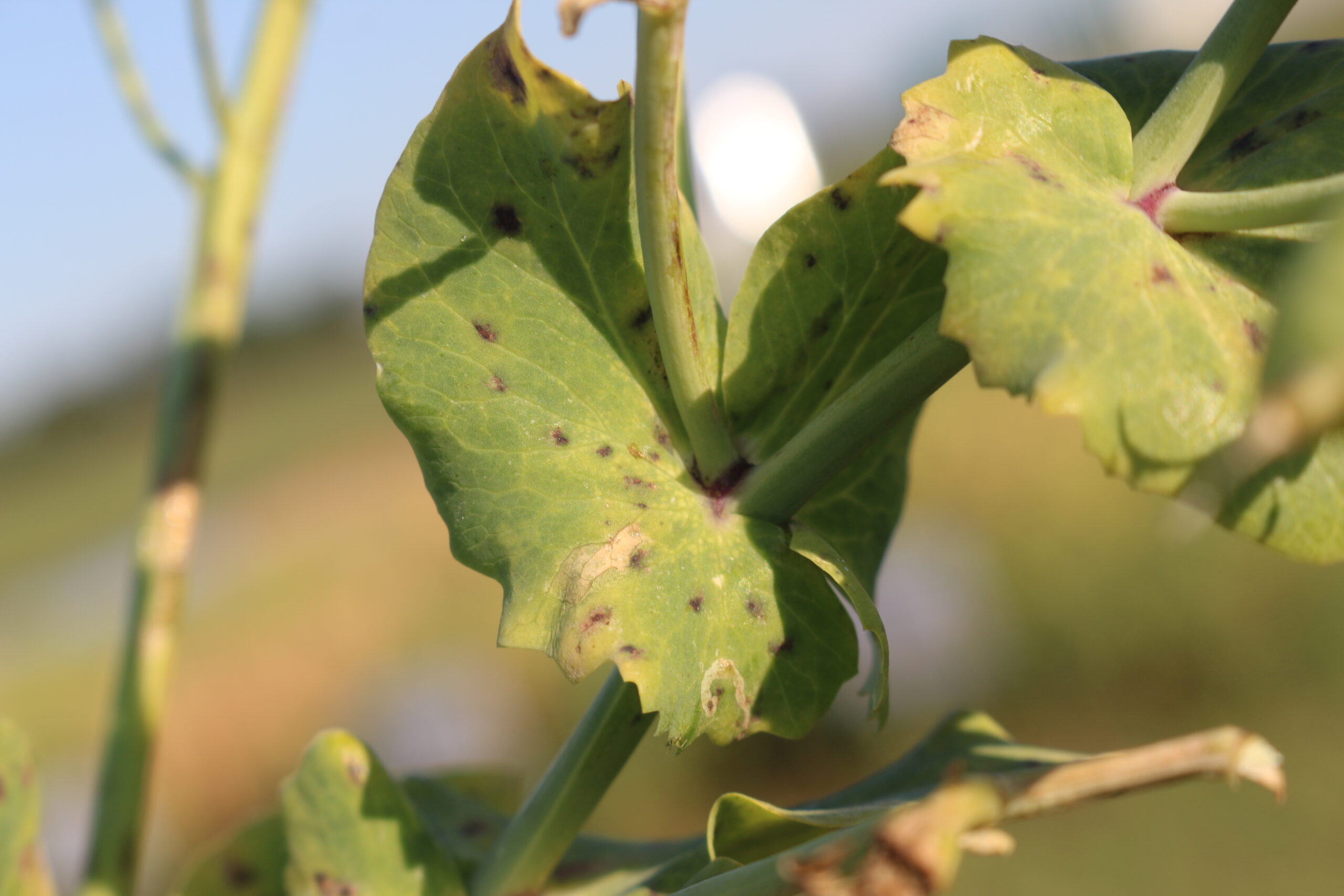
Most ascochyta symptoms observed in the field will be those of mycosphaerella blight, and early symptoms first appear as small, purplish-black to brown spots or lesions on lower stems, leaves, and pods. Severe infections may lead to girdling of the stem near the soil line, which is known as foot rot. Girdling weakens the stem and often results in premature lodging. The impact on yield depends on the timing of initial infection and on weather conditions.
Begin scouting early in the vegetative stage and continue through flowering. Observe whether the disease symptoms are moving upwards in the plant canopy. If symptoms move upward in the plant canopy, beyond the lower third, fungicide application may be warranted. If symptoms do not move beyond the lower third of the plant canopy by the mid-flowering stage, large yield losses would not be expected. A well-established, robust, tall stand will favour more humidity in the canopy, and wet conditions leading up to flowering through to pod set are favourable for disease development. Drier conditions will mean less ascochyta, and impacts on yield will be lower.
The timing of infection, the crop’s yield potential, weather conditions, and the value of the harvested seed will all influence the economics of fungicide application. Tighter crop rotations are more likely to increase disease pressure from the ascochyta complex. If warranted, a fungicide treatment should be applied at the early- to mid-flowering stage for maximum effectiveness. Under high disease levels or very high yield potential, two fungicide applications may be warranted, with the second about 10 to 14 days after the first. To reduce the risk of resistance, rotate fungicide products and modes of action.
Warkentin and other plant breeders are continuing to work on improving resistance in pea varieties; however, for now, selecting varieties listed in the Varieties of Grain Crops 2016 with a better mycosphaerella score and a lower lodging score is a good start. Warkentin notes that on the scale from one to nine for mycosphaerella blight (one=no disease, nine=completely blighted), there is only a small difference between the scores of varieties four to 5.5. However, there is a bit larger variation in lodging resistance, with varieties scoring from 3.5 to 8.5 on a one-to-nine scale (one=completely upright, nine=completely lodged). Varieties that are better at staying upright tend to have less disease and allow the canopy to dry after a rain event.
Ascochyta disease resistance is a complex challenge for pea breeders, with more than 10 resistance genes, each contributing only a small amount, so various strategies are being implemented to improve resistance in varieties.
To help make decisions about whether fungicide application is warranted or based on disease symptomology, please refer to the Fungicide Decision Support Checklist for Ascochyta in Pea.