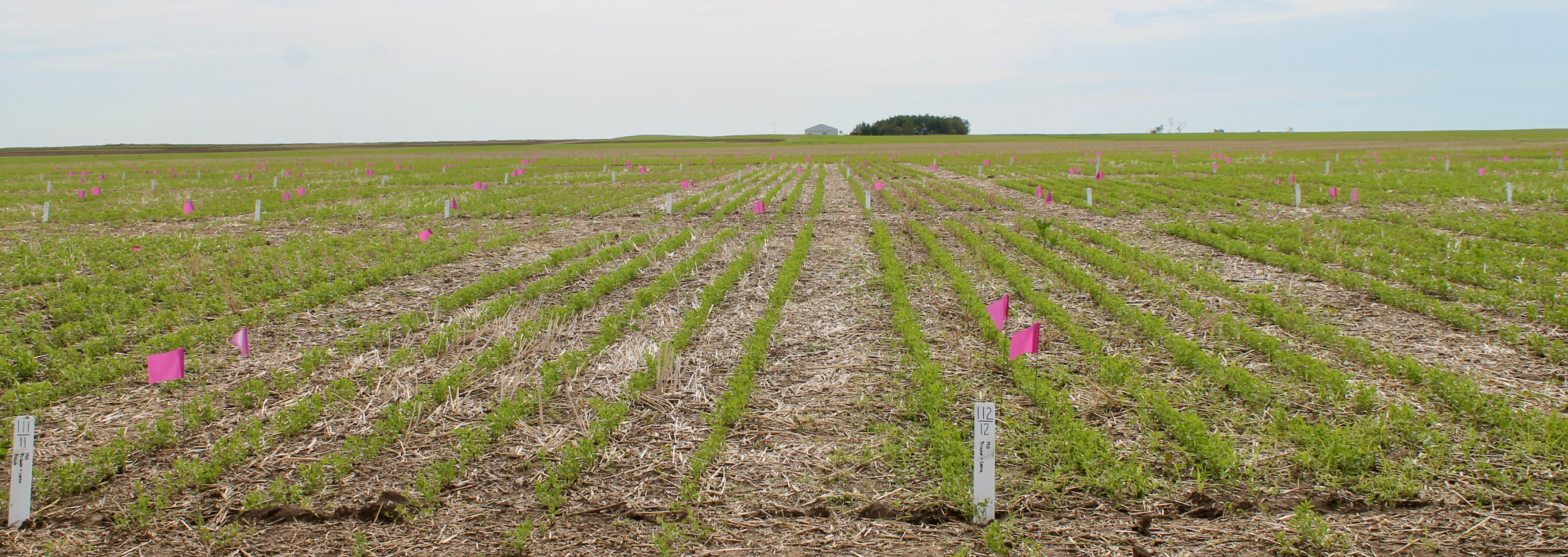
Research Objective
To determine which combination of the common agronomic practices produce the greatest lentil yield; to determine which agronomic practices provide the best economic return to producers.
Integrated management strategies are essential to improve weed control and disease management problems challenging lentil producers in western Canada. A study was conducted over a three-year period at five locations throughout Saskatchewan. The study included three seeding rates (130, 190. and 260 seeds/m2), three fungicide treatments (none, single, and dual application), and two herbicide management practices (pre-seed burnoff vs. pre-seed residual) to total 18 treatments. The response variables measured were crop and weed density, crop and weed dry weight biomass, disease ratings prior to fungicide application, 7, 14, and 21 days after initial application (DAIA), days to flower, days to maturity, seed yield, thousand kernel weights, and test weight.
The results indicated that a pre-seed residual herbicide reduced early season annual weed populations by 66% compared to the traditional pre-seed burnoff strategy.
Weed growth was largely influenced by both seeding rate and herbicide application. The least effective weed management strategy was utilizing the current seeding rate recommendation of 130 seeds/m2 with glyphosate applied alone. If a burnoff strategy is to be used, the seeding rate must exceed 130 seeds/m2 to reduce weed interference. A residual herbicide application was more effective than glyphosate applied alone at all three seeding rates (130, 190, and 260 seeds/m2). The most effective weed management strategy utilized a seeding rate of 190 seeds/m2 combined with a residual herbicide to reduce weed biomass by 76%. Seeding rate also influenced disease severity throughout the growing season. Disease severity tended to increase with seeding rate (260 seeds/m2 > 190 seeds/m2 > 130 seeds/m2). Seeding rates of190 seeds/m2 resulted in disease levels similar to unsprayed lentils at the current seeding rate recommendation (130 seeds/m2). This indicates that if seeding rates are to increase to 190 seeds/m2 then fungicide applications are likely required, particularly under moist conditions. Furthermore, dual fungicide applications tended to have the least amount of disease pressure compared to single applications and unsprayed. Yield was also largely influenced by seeding rate with 190 seeds/m2 resulting in the highest yield compared to seeding rates of 130 and 260 seeds/m2. A seeding rate of 190 seeds/m2 also provided the best economic returns, regardless of management strategy.
The highest net returns occurred with a seeding rate of 190 seeds/m2, unsprayed fungicide, and a residual herbicide application. Although the cost of a fungicide typically reduced net returns compared to the unsprayed, the fungicides should be viewed as a form of insurance rather than an input cost, as disease management is essential for proper lentil production. Additionally, the 15 site-years of experiments were generally conducted under drought conditions with limited disease pressure and therefore may not show the economic benefits associated with fungicide applications. A second factor to consider is the use of a residual herbicide over a burndown weed control method like glyphosate applied alone. In this study, there was limited weed pressure (< 58 plants/m2) and therefore under weedy conditions there would likely be a significant profit with a residual herbicide. Additionally, economic and agronomic benefits to herbicide layering and residual products are likely to be realized over the longer term versus exclusively during the year of application and can also help to mitigate the development of herbicide resistance in weed populations.
Related Resources
Research Summary: Lentil Input Study: An Agronomic and Economic Analysis of Seeding Rate, Herbicide Strategy, and Fungicide Use
Saskatchewan produces approximately 94% of the lentils grown in Western Canada. Due to the poor competitive nature of this crop as well as the increasing presence of herbicide-resistant weeds, one of the major limiting factors for lentil production is effective weed control. Herbicide layering (using two to three herbicides in sequence) and increased seeding rates are both strategies that can be used to improve weed control in lentils. The current recommended seeding rate of 130 plants per square metre (m²) for red lentils may not be adequate enough to provide effective crop-weed competition, yet too high of a seeding rate produces a thicker crop canopy that could increase disease pressure and result in more fungicide use. A study was conducted to evaluate different combinations of common agronomic practices on red lentil yield and to determine which of these agronomic practices would provide the best economic return to producers.
The research study was led by Western Applied Research Corporation (WARC) for three years (2017-2019) throughout Saskatchewan at Scott, Outlook, Indian Head, Swift Current, Yorkton (2017), and Saskatoon (2018 and 2019), for a total of 15-site years. The treatments evaluated were seeding rate (130, 190, and 260 seeds/m²), fungicide (unsprayed, single application, dual application), and herbicide practices (pre-seed burn-off versus pre-seed residual), for a total of 18 individual input combinations. CDC Maxim, a small red lentil variety with good resistance to Ascochyta blight and Anthracnose, was used. All plots were direct-seeded from May 9-26 into cereal stubble, with fertilizer side-banded at seeding rates targeting a 30 bushel per acre (bu/ac) yield (based on soil test recommendations). Granular inoculant was applied at recommended rates adjusted for row spacing. Glyphosate at 360 grams per litre (g/L) (1 L/ac Roundup® equivalent) was used as the pre-seed burn-off treatment and Focus® plus 360 g/L (1 L/ac Roundup® equivalent) of glyphosate was used as the pre-seed residual treatment. Focus® rates were applied based on soil types at the individual sites. The herbicide treatments were applied 3-5 days prior to seeding. Ares™ and Centurion® were applied post-emergent in all treatments. The single fungicide application was the high rate of 180 millilitres per acre (mL/ac) of Priaxor® applied at the beginning of flowering. The dual fungicide application consisted of Priaxor® followed by Lance® WDG 10-14 days after the single application.
Effects on Lentil Establishment and Weed Density
Lentil establishment increased as the seeding rate increased. The average plant densities achieved were 186, 146, and 105 plants/m² at the targeted seeding rates of 260, 190, and 130 seeds/m². These results translate into respective seed survival rates of 72, 77, and 82%.
The pre-seed residual herbicide provided a 66% increase in early season annual weed control compared to pre-seed glyphosate alone at nine out of the 14 site-years. Annual weeds controlled included green foxtail, cleavers, redroot pigweed, volunteer canary seed, as well as suppression of kochia and wild oats. Despite the very dry spring conditions at some of the sites (such as Swift Current), the efficacy of the residual herbicide, which requires rainfall for activation, was not reduced and excellent weed control was still achieved.
Effects on Weed Biomass
The effect of seeding rate on weed control depended on the herbicide treatment used at 11 out of 15 site-years (73% of the time). When glyphosate was applied alone, weed biomass decreased as seeding rate increased. Specifically, there was a 53% reduction in weed biomass when seeding rate increased from 130 seeds/m² to 190 seeds/m², and a 64% reduction in weed biomass when seeding rate increased from 130 seeds/m² to 260 seeds/m² with glyphosate alone. However, there was no significant effect of seeding rate on weed biomass when the residual herbicide was used. Using the residual herbicide in combination with glyphosate reduced weed biomass at all seeding rates compared to glyphosate alone, but this difference was greatest at the low seeding rate (130 seeds/m²) (Figure 1). At 130 seeds/m², including a residual herbicide decreased weed biomass by 65% compared to using glyphosate alone.

Figure 1. Effect of seeding rate and herbicide applications on weed biomass at physiological maturity. Points represent 11 responsive site years. Line equation for the glyphosate applied alone: y= -1.4445x +460.32; R²= 0.8469. Line equation for the residual herbicide is y= -0.1627 x + 117.41; R²= 0.4324
Source: Jessica Weber, et al (2020).
Increasing the seeding rate allows the crop to become established in the available space earlier than the weeds, allowing it to better compete for water, nutrients, light, and space. The benefits of higher seeding rates were more evident when glyphosate was applied alone, since long-term weed control with glyphosate is much less than with the residual herbicide.
Effects on Lentil Disease Severity
Lentil disease severity was impacted by both seeding rates and fungicide use (Table 1). As seeding rates increased, disease severity also increased, a significant trend that began early on in the growing season prior to fungicide application. Also, the unsprayed lentils had the highest disease pressure compared to the fungicide treatments. There was no significant difference in disease severity between the single and the dual fungicide applications, which could be due to the dry conditions experienced during this study.
Table 1. Main effect means and interactions for lentil disease severity (%) collected
Treatment/ Main Effects |
Prior to Application |
7 DAIA |
14 DAIA |
21 DAIA |
|---|---|---|---|---|
Seeding Rate (SR) |
Disease Severity (%) |
|||
130 seeds/m2 |
11 a |
13 a |
19 a |
21 a |
190 seeds/m2 |
11 ab |
14 ab |
22 b |
26 b |
260 seeds/m2 |
12 b |
15 b |
25 c |
31 c |
Herbicide (HR) |
Disease Severity (%) |
|||
Glyphosate |
11 a |
14 a |
23 a |
27 a |
Glyphosate & Residual |
11 a |
14 a |
22 a |
25 a |
Fungicide (FG) |
Disease Severity (%) |
|||
None |
11 a |
15 a |
26 a |
31 a |
Single |
11 a |
13 b |
21 b |
24 b |
Dual |
11 a |
13 b |
20 b |
23 b |
FG x SR |
Disease Severity (%) |
|||
None x 260 seeds/m2 |
12 a |
16 a |
30 a |
38 a |
None x 190 seeds/m2 |
11 a |
15 a |
26 a |
32 b |
Single x 260 seeds/m2 |
11 a |
14 a |
23 a |
29 b |
Dual x 260 seeds/m2 |
12 a |
14 a |
23 a |
27 bc |
Dual x 190 seeds/m2 |
11 a |
13 a |
21 a |
24 cd |
Single x 190 seeds/m2 |
11 a |
14 a |
20 a |
24 cd |
None x 130 seeds/m2 |
11 a |
14 a |
21 a |
23 cd |
Single x 130 seeds/m2 |
11 a |
13 a |
18 a |
20 d |
Dual x 130 seeds/m2 |
10 a |
13 a |
18 a |
20 d |
Table above shows main effect means and interactions for lentil disease severity (%) collected prior to fungicide applied, 7, 14, and 21 days after initial application (DAIA) averaged across 13-site years in Scott, Outlook, Swift Current, Indian Head, and Yorkton, SK. Main effect means within a column followed by the same letter do not significantly differ.
Source: Jessica Weber, et al (2020).
At 21 days after the initial fungicide application (DAIA), the herbicide treatments showed a significant interaction on disease development. The disease severity of glyphosate alone was higher than the residual herbicide treatment. This could be due to the residual herbicide providing better weed control throughout the season. In most years, the glyphosate-only treatments had more weed growth, creating a thicker canopy with less air-flow, and therefore providing an environment more conducive to disease development.
Also at 21 DAIA, the seeding rate by fungicide treatments significantly affected disease severity, whereby the effectiveness of the fungicide was dependent upon the seeding rate used (Figure 2). At 130 seeds/ m² there was no disease reduction in the single or dual fungicide treatments compared to untreated. However, at rates greater than 190 seeds/m², single and dual fungicide applications reduced disease severity by 26% compared to untreated lentils. At 260 seeds/m², the dual fungicide application had 9% less disease than the single application, but this difference was not significant. Overall, seeding rates greater than 130 seeds/m² required the use of fungicides in order to manage disease, even in dry growing conditions.

Figure 2. Effect of lentil seeding rate on disease severity ratings (0-100%) at 21 days after initial application (DAIA) with a significant interaction between a continuous (seeding rate) x categorical (fungicide) interaction (P= 0.0217) at 13 site-years. Standard error bars indicate significant differences between main effects. Line equation for no fungicide: y=0.1113x + 9.5247; R² = 0.9771. Line equation for single fungicide: y = 0.0702x + 10.793; R² = 0.9863. Line equation for dual fungicide: y = 0.0509x + 13.594; R² = 0.9885
Source: Jessica Weber, et al (2020).
Disease Risk Decisions
Disease development in lentils is impacted by many factors, particularly previous crop history, moisture conditions, soil texture, and varietal genetic resistance. If one or more of these factors are high risk (frequent cropping, high moisture, heavy clay soil, poor varietal disease resistance), then there will likely be a seeding rate by fungicide interaction, meaning that the seeding rate used will influence fungicide performance.
Therefore, based on this study:
- High risk zones with a seeding rate >130 seeds/m² should use a minimum of one fungicide application
- Moderate to low risk zones may use a higher seeding rate (190 seeds/m²) plus a single fungicide application with a fairly low risk of excessive disease pressure
- Seeding at 260 seeds/m² is considered risky, even under ideal conditions with dual fungicide applications
Effects on Lentil Flowering and Maturity
The only factor that influenced days-to-flowering and days-to-maturity in lentils was seeding rate. However, this effect was very minor with only 0.2 days and 0.5 days difference between the longest and shortest days-to-flowering and days-to-maturity, respectively. Fungicides, herbicides, or any combination of the three main effects did not result in a significant difference in flowering or maturity over 14 site-years.
Effects on Lentil Yield
There was a significantly lower lentil yield (6%) at 130 seeds/m² compared to 190 seeds/m² across all 15 site-years. Although the 190 seeds/m² seeding rate showed a yield gain of 29 kilograms per hectare (kg/ha) over the 260 seeds/m² rate, this difference was not significant. Seeding rate effects on yield were variable from site to site, largely influenced by the environmental conditions.

Figure 3. Glyphosate + Focus® on left vs. glyphosate alone on right at 190 seeds/m² at Scott, SK in 2017. Using a residual herbicide with glyphosate and seeding at 190 seeds/m² reduced weed biomass by 76% and was found to be the most effective weed management strategy.
Source: Jessica Enns (Weber), 2020.
Seeding Rates & Critical Period of Weed Control
In this study, seeding rates played a significant role in yield and can be contributed to early season weed management during the critical period of weed control (CPWC). The CPWC is the period of crop growth when weeds must be controlled in order to prevent yield loss. For lentils, the CPWC is from the 5-node to the 10-node (approximately canopy closure) stage (Fedoruk et al. 2011). Previous research found that the removal of weeds at the 5-node stage caused a 4% yield loss in lentils but later removal of the weeds at the 7-node stage resulted in a 16% yield loss (Fedoruk et al. 2011). The most effective weed management strategy in the current study was using a higher seeding rate (>130 seeds/m²) with a residual herbicide in order to better reduce weed competition during the CPWC of lentils. While the benefit of the residual herbicide will be more evident in weedier conditions, the benefit of increased seeding rates will be realized under low or high weed pressure.
Economic Analysis
Of the different seeding rates, the 190 seeds/m² rate averaged the highest net return ($891/ha, or $361/ac) (Table 2). The treatment with the highest net return was 190 seeds/m², residual herbicide, and no fungicide ($954/ha, or $386/ac). In general, the fungicides produced lower net returns compared to the unsprayed treatments, but this study was conducted under drier than normal years which limited disease pressure. Fungicides should be considered as insurance to protect yield, rather than an input cost, as disease management is essential to lentil production especially under higher moisture or disease conducive conditions.
Table 2. Economic analysis of the production management strategies with yields based on the 15 site-year yield means (kg/ha) with market price fixed at $0.44/kg.
Seeds/m2 |
Fungicide & Herbicide Application |
Yield (kg/ha) |
$/kg |
Gross Revenue |
Production Expenses |
Net Revenue |
|---|---|---|---|---|---|---|
130 |
Unsprayed & Glyphosate |
2444.7 |
$0.44 |
$1,078 |
$178 |
$900 |
Unsprayed & Residual |
2500.0 |
$0.44 |
$1,102 |
$215 |
$887 |
|
Single & Glyphosate |
2532.3 |
$0.44 |
$1,116 |
$246 |
$870 |
|
Single & Residual |
2575.6 |
$0.44 |
$1,136 |
$283 |
$852 |
|
Dual & Glyphosate |
2516.3 |
$0.44 |
$1,109 |
$312 |
$797 |
|
Dual & Residual |
2527.6 |
$0.44 |
$1,114 |
$349 |
$765 |
|
190 |
Unsprayed & Glyphosate |
2604.8 |
$0.44 |
$1,148 |
$203 |
$945 |
Unsprayed & Residual |
2708.2 |
$0.44 |
$1,194 |
$240 |
$954 |
|
Single & Glyphosate |
2715.5 |
$0.44 |
$1,197 |
$271 |
$926 |
|
Single & Residual |
2718.9 |
$0.44 |
$1,199 |
$308 |
$890 |
|
Dual & Glyphosate |
2636.6 |
$0.44 |
$1,162 |
$337 |
$825 |
|
Dual & Residual |
2673.8 |
$0.44 |
$1,179 |
$375 |
$804 |
|
260 |
Unsprayed & Glyphosate |
2651.9 |
$0.44 |
$1,169 |
$229 |
$941 |
Unsprayed & Residual |
2666.0 |
$0.44 |
$1,175 |
$266 |
$910 |
|
Single & Glyphosate |
2615.7 |
$0.44 |
$1,153 |
$296 |
$857 |
|
Single & Residual |
2695.8 |
$0.44 |
$1,189 |
$334 |
$855 |
|
Dual & Glyphosate |
2609.0 |
$0.44 |
$1,150 |
$363 |
$788 |
|
Dual & Residual |
2648.0 |
$0.44 |
$1,167 |
$400 |
$768 |
Source: Jessica Weber, et al (2020).
Another factor that could have influenced the pre-seed burn-off economics was the weed density. Overall, the plots had very low weed density (<58 plants/m²). Therefore, the additional cost associated with the residual herbicide compared to using glyphosate alone may not be fully realized under lower weed pressure versus higher weed pressure. To illustrate this point, an economic analysis using a weed density of 216 plants/m² was conducted. The results found a net profit increase of 17%, 5%, and 0% at 130, 190, and 260 seeds/m² for the residual herbicide compared to using glyphosate alone.
Key Findings
- Using a pre-seed residual herbicide reduced early season annual weed populations by 66% compared to the traditional pre-seed burn-off strategy of glyphosate alone.
- The least effective weed control strategy was using the current seeding rate recommendation of 130 seeds/m² with glyphosate only. The most effective weed management strategy utilized a seeding rate of 190 seeds/m² combined with a residual herbicide – this combination reduced weed biomass by 76%.
- Disease severity increased with seeding rate (260 seeds/m² > 190 seeds/m² > 130 seeds/m²). At 190 seeds/m², disease levels were similar to the unsprayed lentils at the current seeding rate recommendation of 130 seeds/m². A single fungicide application is required when the seeding rate targets 190 seeds/m². Dual fungicide applications may be required under conditions that promote higher disease pressure.
- A seeding rate of 190 seeds/m² resulted in the highest yield compared to seeding rates of 130 and 260 seeds/m².
- A seeding rate of 190 seeds/m² also resulted in higher net returns than 130 and 260 seeds/m², regardless of management strategy. The highest net returns occurred with a seeding rate of 190 seeds/ m², no fungicide, and a residual herbicide application.
- The cost of a fungicide typically reduced net returns compared to the unsprayed treatments. However, fungicides should be viewed as a form of insurance rather than as an input cost, as disease management is essential for maximum lentil production. Additionally, the experiments in the 15-site years of this study were generally conducted under drought conditions with limited disease pressure and therefore may not show the economic benefits that might be associated with fungicide applications under a wider range of conditions.
Acknowledgements
This project was jointly funded through Saskatchewan Pulse Growers, Western Grains Research Foundation, and the Canada-Saskatchewan ADF program (administered by Saskatchewan Ministry of Agriculture). Special thanks to Indian Head Agriculture Research Foundation, Irrigation Crop Diversification Corporation, Western Applied Research Corporation, Wheatland Conservation Area, East Central Research Foundation, and the University of Saskatchewan for conducting trials for this project at their sites. Various crop protection products were provided in-kind.
- Weber, J., Nybo, B., Hall, M., Holzapfel, C., Johnson, E., Shirtliffe, S. and Hnatowich, G., 2020. Lentil input study. AGR1701.
- Fedoruk, L.K., Johnson, E.N. and Shirtliffe, S.J., 2011. The critical period of weed control for lentil in western Canada. Weed Science, 59(4), pp.517-526.