Contributing Researchers: Dr. Chris Willenborg, Sid Darras, Eric Johnson, and Dr. Dilshan Benaragama
Introduction
Weed control is a key challenge for chickpea growers. Chickpeas are poor competitors against weeds, and weed control options are sparse. Additionally, because few herbicide options exist, weed resistance is a major threat to chickpea growers. To improve weed control options and combat the development of weed resistance, Saskatchewan Pulse Growers (SPG) funded three chickpea weed management research projects. Two projects investigated the group 6 active known as pyridate, exploring its crop safety and effectiveness on kochia. A third project examined the phytotoxicity and yield impacts of Sencor® and Authority® alone and in combination with seven different chickpea varieties. These research projects aimed to further improve weed management in chickpeas by exploring new herbicide actives and crop safety of currently used herbicides.
Chickpea Pyridate Tolerance
Pyridate is a group 6 herbicide that selectively controls broadleaf weeds, including kochia, lambsquarters, redroot pigweed, and wild mustard. Pyridate was assessed in the 1990s for suitability in chickpeas and was found to have potential as a weed control option. Registration of the active, marketed by Syngenta at the time, was not pursued, however. Currently, pyridate is owned by Belchim Crop Protection with the trade name Tough 600EC® for pre-seed use in chickpeas, lentils, and peas, and post-emergent use in chickpeas. In 2019 and 2020, SPG funded research to assess the in-crop tolerance of pyridate in chickpeas, flax, field peas, and faba beans to explore this new pulse herbicide opportunity. Pyridate was applied at 900 and 1800 g active ingredient per hectare (ai/ha), the 1x and 2x rates, respectively, in 2019 and at 300 and 600 g ai/ha in 2021. The pyridate treatments were compared to a hand-weeded untreated check and Sencor® 75DF, a commonly used in-crop chickpea herbicide.
In both 2019 and 2020, chickpea crop injury from pyridate application was acceptable, below 10%. Additionally, no yield reductions were observed, indicating that pyridate is safe for in-crop use in chickpeas.
Weed Control Efficacy of Pyridate in Chickpeas
With crop safety of pyridate on chickpeas established, research focus turned to establishing the efficacy of pyridate on kochia, a main weed concern in chickpea-growing regions. Kochia is a weed that readily develops herbicide resistance, and group 2, 4, and 9 resistant biotypes have been identified across the prairies. Currently, the main in-crop herbicide in chickpeas is the group 5 product Sencor®. The discovery of another herbicide group effective on kochia would be a key tool for combating weed resistance in chickpeas. To explore the efficacy of pyridate on kochia, pyridate and Sencor® were compared with an untreated, unweeded check at multiple rates, applied both separately and tank-mixed (Table 1). Herbicide timing also varied among treatments, with applications at kochia heights of 1–4 cm and 5–10 cm. Research took place at the Kernen Research Farm in Saskatoon from 2018 to 2020. CDC Alma, a kabuli chickpea variety, was used. Visual injury, visual weed control efficacy, and crop yield were assessed.
Table 1. Treatments for the timing of pyridate herbicide treatments for kochia control in chickpea
| Treatment No. | Herbicide | Rate (g ai/ha) | Application timing (kochia height) |
|---|---|---|---|
| 1 | Untreated | ||
| 2 | Sencor® 480 | 101 | 1–4 cm |
| 3 | Sencor® 480 | 198 | 1–4 cm |
| 4 | Pyridate 600EC | 450 | 1–4 cm |
| 5 | Pyridate 600EC | 900 | 1–4 cm |
| 6 | Pyridate 600EC | 450 | 1–4 cm |
| Pyridate 600 | 450 | 5–10 cm | |
| 7 | Pyridate 600EC | 300 | 1–4 cm |
| Sencor® 480 | 101 | 1–4 cm | |
| 8 | Pyridate 600EC | 600 | 5–10 cm |
| Pyridate 600EC | 300 | 1–4 cm | |
| 9 | Sencor® 480 | 101 | 1–4 cm |
| Pyridate 600EC | 300 | 5–10 cm | |
| Sencor® 480 | 101 | 5–10 cm | |
| 10 | Sencor® 480 | 198 | 1–4 cm |
| Pyridate 600EC | 900 | 5–10 cm | |
| Pyridate 600EC | 900 | 5–10 cm | |
| Sencor® 480 | 101 | 5–10 cm | |
| 11 | Sencor® 480 | 198 | 1–4 cm |
| Pyridate 600EC | 900 | 5–10 cm | |
| 12 | Pyridate 600EC | 900 | 5–10 cm |
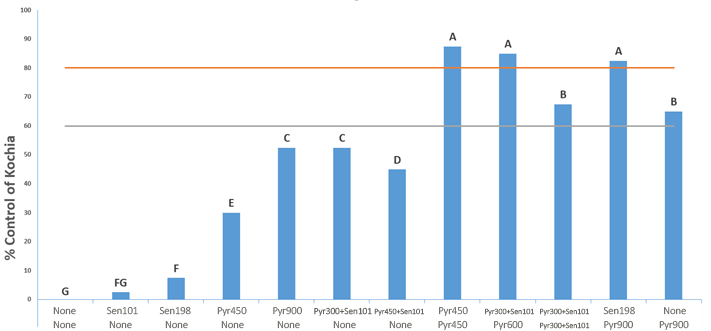
As expected, pyridate produced no visual chickpea crop injury in any of the treatments in this study. Treatment 8 (pyridate 450 g ai/ ha at both 1–4 cm and 5–10 cm), treatment 9 (pyridate at 300 g ai/ ha tank mixed with Sencor® at 101 g ai/ha at 1–4 cm, and pyridate at 600 g ai/ha at 5–10 cm), and treatment 11 (Sencor® at 198 g ai/ ha at 1–4 cm and pyridate at 900 g ai/ha at 5–10 cm) resulted in the highest kochia control at over 82% (Figure 1). Treatment 10 (pyridate at 300 g ai/ha and Sencor® at 101 g ai/ha at both 1–4 cm and 5–10 cm) and treatment 12 (pyridate at 900 g ai/ha at 5–10 cm) produced 60 to 80% kochia control, with all other treatments at less than 60% control. The only treatments that provided marginal kochia control (above 80%) were those with an application timing on kochia at 5–10 cm and 1–4 cm. In general, pyridate provided marginal control of kochia in combination with Sencor®. Both Sencor® and pyridate provide similar activity on kochia; however, further work is needed to identify a tank-mix partner with Sencor® that provides more diverse activity on kochia.
Varietal Differences in Sulfentrazone and Metribuzin Tolerance in Chickpeas
Reports of mysterious health issues in chickpea crops in Southern Saskatchewan began in 2019 and have continued in subsequent seasons. Herbicide residue and chickpea variety have both been identified as potential drivers of the health issue. To further investigate, Sulfentrazone (Authority®) pre-emergent and metribuzin (Sencor®) alone and in combination were assessed on seven different imi-tolerant chickpea varieties to determine varietal differences in crop phytotoxicity and yield. The treatments included a hand-weeded untreated check, Authority® pre-only, Sencor® post-only, and Authority® pre with Sencor® post. Sencor® was applied to the crop at the 2-node stage. The chickpea cultivars tested were CDC Leader, CDC Orion, CDC Lancer, CDC Orkney, CDC Pasqua, CDC Consul, and CDC Kala, and each cultivar received all four treatments, for a total of 28 treatments. Trials took place at Kernen and Goodale research sites in 2021.
Results showed that all the chickpea varieties had similar phytotoxicity and yield responses to the herbicide treatments. The herbicide treatments, however, differed in their impact on crop phytotoxicity. At 14 days after emergence (DAE) at both sites, Authority® pre with Sencor® in-crop produced phytotoxicity symptoms above the acceptable 10% level at 13% (Figure 2). Sencor® alone produced some phytotoxicity below 10%, and Authority® produced no phytotoxicity. Results varied between sites at 25 DAE. At Kernen, all treatments had phytotoxicity below 10%, with Sencor® and Authority® producing higher phytotoxicity than Authority® alone (Figure 3a). At Goodale, phytotoxicity exceeded acceptable levels for Sencor® and Sencor® with Authority® at 11% and 13%, respectively, potentially due to the sandier, lower-organic-matter soil (Figure 3b). Herbicide treatment and chickpea variety both had statistically significant effects on crop yield, but the two factors did not interact. The herbicide treatments yielded 32% higher than the control (Figure 4). As well, Authority® in combination with Sencor® produced a 35% higher yield than either herbicide treatment alone.
Authority® alone had very low phytotoxicity, with Sencor® at slightly higher phytotoxicity levels, but still within the acceptable range. Authority® and Sencor® in combination produced phytotoxicity slightly above 10%; however, yields were highest in the combined treatment, likely due to reduced early-season weed competition. Regarding the chickpea health issue, the observed crop damage from Authority® and Sencor® may be related to it. Health issue symptoms were not observed in the study; however, conclusions on the connection between herbicides and health issues cannot be drawn from this study. The yield improvement from using Authority® and Sencor® in combination appeared to outweigh any crop damage from the joint herbicide treatments, with no difference between chickpea varieties. Use of Authority® pre-emerge and Sencor® in-crop is recommended, therefore, regardless of chickpea variety.


Conclusions and Recommendations
The exploration of group 6 pyridate showed that it is a safe, active ingredient for application on chickpeas. The efficacy of pyridate on kochia, however, was marginal. Pyridate provided over 82% kochia control when used in combination with Sencor®, with only two in-crop applications versus one application. From this research, pyridate will provide activity against kochia; however, because pyridate has similar activity to Sencor®, further research into a more diverse active with stronger activity against kochia is needed.
Investigation into current chickpea herbicide actives showed that Authority® pre-emergent and Sencor® in crop applied in combination produced phytotoxicity symptoms above the acceptable 10% level, with no difference in response between the seven chickpea varieties. Although phytotoxicity was higher when the herbicides were applied together than when applied separately, yield was 35% higher than with either herbicide alone. The benefits of extending weed control from pre-emergence through in-crop outweighed yield loss from crop damage. As well, herbicide layering of pre-emergent residuals and in-crop products is an effective tool for combating herbicide resistance. As such, chickpea growers should continue using pre-emergent residuals such as Authority® along with Sencor® in the crop regardless of the chickpea variety.

Enhancing weeds science in pulse crops: Towards a robust strategy for long-term weed management
Dr. Christian Willenborg University of Saskatchewan – Dept. of Plant Sciences Objective