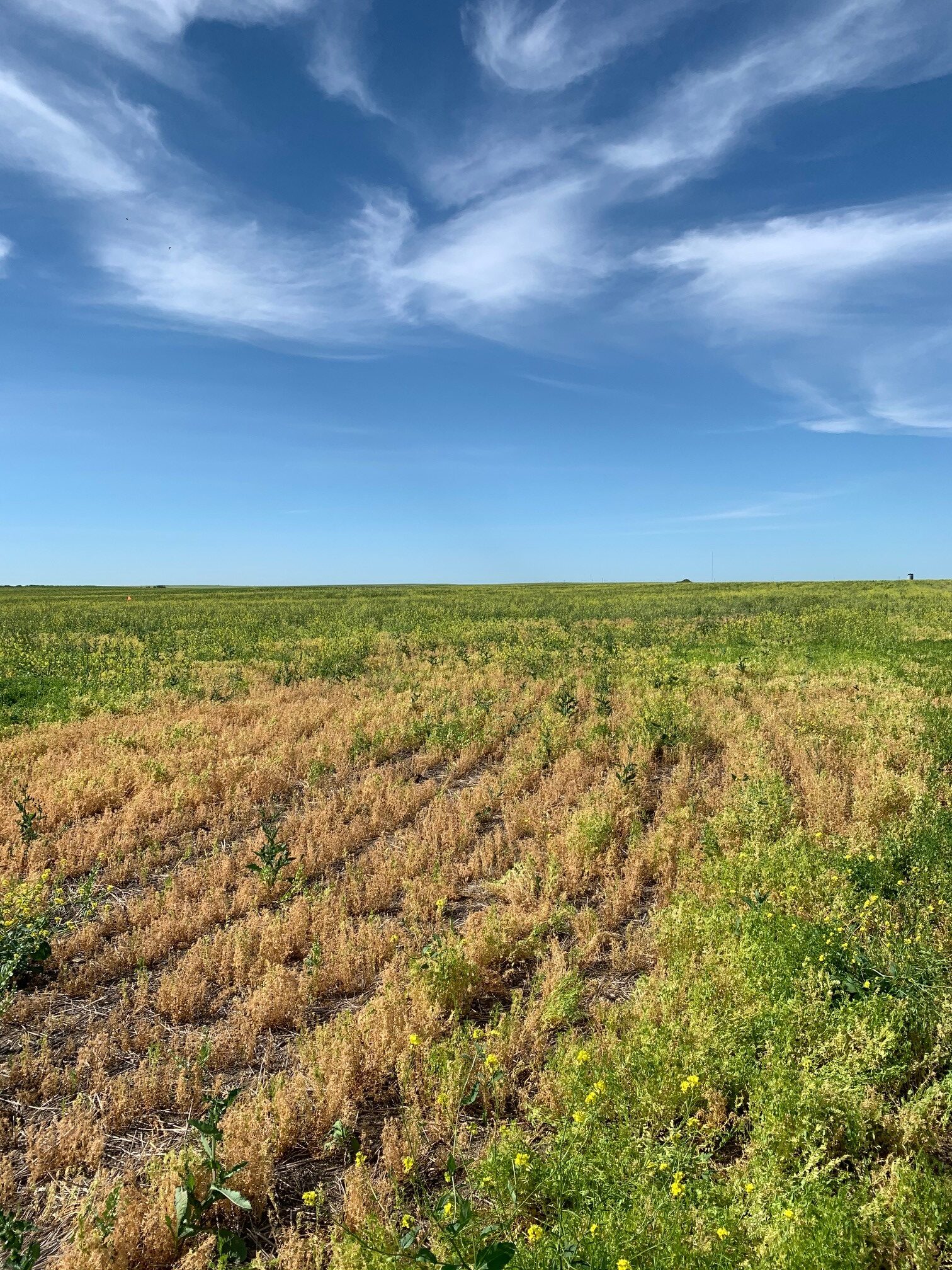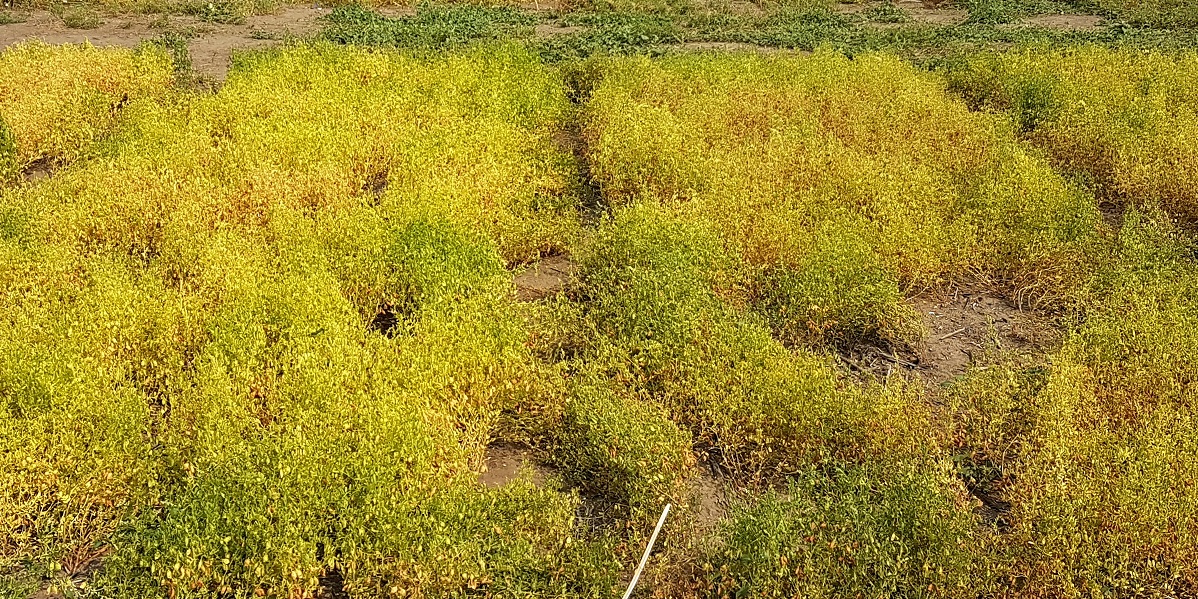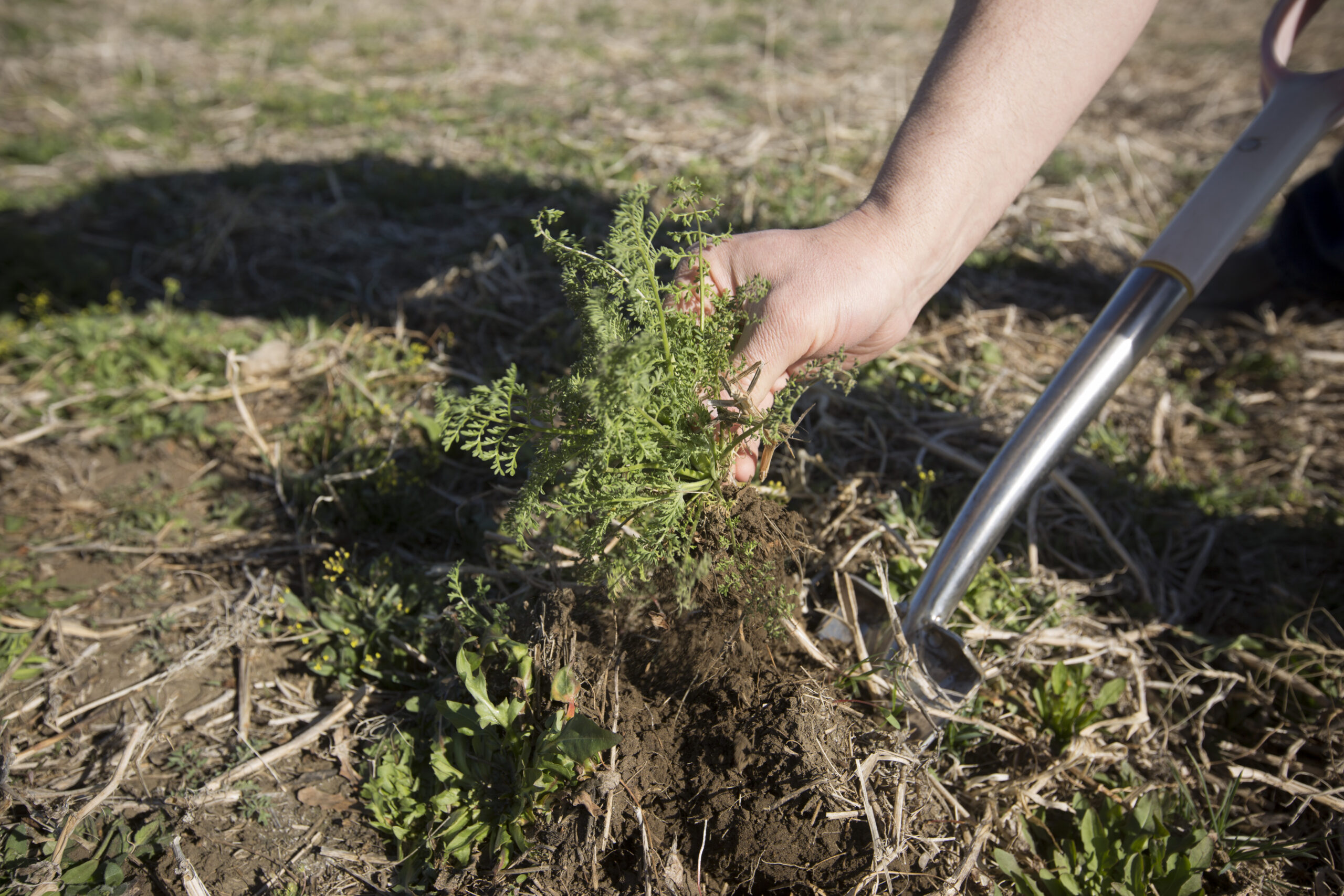
Growers have consistently identified weed control as a top issue. In 2025, Saskatchewan Pulse Growers (SPG) launched a six-year, $3.67 million weed science research program to provide more weed control options.
“SPG has long recognized that weed control has been one of the main issues for pulse producers,” says SPG Research Project Manager Allison Fletcher. “Over 15 years ago, we started taking a program-style approach to funding research in this area, recognizing that by taking this larger approach, we could create some efficiencies.”
Now in its second year, the program is funding five projects to develop practical, effective weed control strategies that help growers optimize yields without burdening their bottom line. Those projects are:
- Framework for a collaborative kochia management program in pulses — Dr. Steve Shirtliffe, University of Saskatchewan
- Investigating the potential of directed energy (blue light and mid-wave infrared light) as a method of harvest weed seed control on Canadian weeds — Dr. Shaun Sharpe, Agriculture and Agri-Food Canada (AAFC), Saskatoon, Sask.
- Investigating weeds as alternative hosts to root rot disease complex in pulses — Dr. Syama Chatterton, AAFC, Lethbridge, Alta.
- Developing robust weed management strategies for pulse and soybean crops by integrating herbicides, cultural strategies and drone spot spraying — Dr. Dilshan Benaragama, University of Manitoba
- Utilization of crop life cycle diversity and crop diversity to manage herbicide-resistant kochia in pulses — Jessica Enns, Western Applied Research Corporation, Scott, Sask.
A webinar in May 2026 brought growers up to date on Dr. Sharpe and Dr. Chatterton’s projects, while Dr. Sharpe and Racquelle Peters gave preliminary updates on some of the initiatives under the collaborative kochia management framework. View the webinar.
 Video
Video
Pulse Research Webinar: Weed Program Update
Further project updates are outlined below:
Utilization of Crop Life Cycle Diversity and Crop Diversity to Manage Herbicide-Resistant Kochia in Pulses
This four-year study aims to evaluate yellow sweet clover (Melilotus officinalis Desr.) within a diverse rotation and develop an integrated weed management strategy for herbicide-resistant kochia. Yellow sweet clover has strong allelopathic potential, with allelochemicals that can reduce seed germination and may help suppress kochia establishment. The rotation also incorporates crops with contrasting life cycles to disrupt kochia emergence, growth, and seed production while reducing reliance on herbicides.
Field trials were initiated at Scott and Saskatoon in 2025 to evaluate combinations of crop types, clover harvest methods, herbicide management, and subsequent crop phases.
Preliminary 2025 results showed:
- Crop type significantly affected crop density and kochia height at both locations.
- Yellow sweet clover established at higher densities than canola at both sites.
- Higher clover density did not consistently reduce kochia density.
- Kochia was consistently taller in canola than yellow sweet clover.
- Clover establishment and canola yield did not differ among treatments at Scott.
- At Saskatoon, clover establishment differed among treatments, while canola yield differences could not be attributed to management effects.
In 2026, clover was green-manured, mowed, or baled, and followed by field pea. Fall rye, winter wheat, and spring wheat will follow in 2027, then small red lentils in 2028.
Developing Robust Weed Management Strategies for Pulse and Soybean Crops by Integrating Herbicides, Cultural Strategies, and Drone Spot Spraying
With the threat of glyphosate resistance looming, this project takes a layered approach to understanding and evaluating how well different weed management and herbicide systems work for lentil, pea, and soybean crops by combining herbicides, cultural practices, and precision agriculture to develop a more robust system.
The first field experiments on pre-emergence and post-emergence herbicides and cultural practices were done at multiple locations in Manitoba and Saskatchewan in 2025 and continued in 2026. The team tested drones’ physical capabilities in 2025 and 2026 in preparation for herbicide spot-spray tests beginning in 2027. Agronomy and phenology were investigated in separate experiments in 2025 and 2026, but will be integrated in 2027 to determine how the different layers complement each other.
Framework for a Collaborative Kochia Management Program in Pulses
This wide-ranging, six-year collaborative framework brings together researchers, producers and the industry to conduct field-scale testing and on-farm demonstrations across geographically diverse locations in Saskatchewan and Alberta to produce practical, consistent, scalable recommendations for kochia control in pulse crops.
The framework has three areas of focus:
Chemical management
- Efficacy screening of new herbicide options in pulse crops
- Determining a biologically effective dose for controlling kochia with metribuzin
- Prairie-wide metribuzin resistance survey
Saline landscape management
- Weed control in natural saline patches
- Targeted soil-applied herbicide layering
Mechanical seed bank management
- Long-term patch mowing demonstration
- Mowing timing trials
Preliminary results include:
Mowing timing trials: Kochia biomass was significantly reduced when fields were mowed twice, in late July and August, in 2025. Work is ongoing to determine if the biomass reduction correlates with less Kochia seed being returned to the soil and fewer weeds in subsequent years.
Prairie-wide metribuzin resistance survey: Samples continue to be collected, but so far no Group 5 resistance has been recorded in any sample.
Herbicide screening trial: Metribuzin-based co-packs applied for kochia control in fall 2025 did not reduce lentil stand at any site. Lentil injury was low overall, indicating that crop tolerance to herbicide programs was generally acceptable under the study conditions. Kochia control clearly differed among treatments. The strongest, most consistent control came from fall-applied metribuzin-containing programs, especially Fierce® MTZ, Bifecta® EZ, and Sencor®. Kochia biomass reductions supported this.