Project lead: Dr. Jodi Souter, J4 Agri-Science.
Background
Faba bean is currently a minor crop in Canada, but its ability to grow in colder, wetter climates, combined with increasing consumer demand for plant-protein products, reduced fertilizer costs to producers due to efficient nitrogen fixation, and demonstrated ecological benefits, all signal huge potential for this crop to become a viable legume option for northern growing regions of Saskatchewan. However, large-scale production in the region hinges on breeders developing varieties with greater agronomic reliability.
A key issue with faba bean is its long lifecycle. Varieties commercially available in Saskatchewan reach maturity in 104 to 110 days. Still, consistent production in northern growing regions requires faba beans to ideally reach maturity in 95 to 100 days to produce good-quality seed before frost and to help protect the crop from pests, diseases, and heat during flowering.
Additionally, while faba bean’s potential partial resistance to Aphanomyces root rot and anthracnose makes it an attractive legume option for Saskatchewan, its susceptibility to chocolate spot limits its viability. Previous researchers have documented several sources of genetic resistance, and some level of resistance has been introduced in other countries. Breeding chocolate-spot-resistant Canadian varieties would reduce the need for fungicides and make faba bean a more dependable option for large-scale production in the province.
Design of Experiment
This multi-year project used large mass-crossing events and strict selection to quantitatively breed for both earlier maturity and chocolate spot resistance in faba bean, to develop a mass-hybridization population of material for future development.
Year 3 was carried out by J4 Agri-Science (J4) from February 1, 2024, to January 31, 2025, and focused on selecting plants from segregating lines based on earlier maturity (both early-flowering and early-maturing) or reduced symptoms when infected with the chocolate spot pathogen, Botrytis fabae. In addition to material previously developed by J4, global faba bean germplasm was accessed for use in the project.
Early maturing field trials
In 2023, early-flowering and early-maturing lines were marked with flags and harvested individually. That fall, the seeds were sown in a crossing block in a growth chamber, and plants were grown in 8-inch pots in a greenhouse, heated to 22°C during the day and 20°C at night, with 20 hours of daylight. Flower development and fertilization rates were low. Crosses were selfed and then repotted into larger (10-inch) pots to increase health and fertility while reducing plant stress.
For the early-maturing field trials, seeds from these new lines, as well as from some previously developed lines, were planted in the field at 3-inch intervals in rows spaced 24 inches apart on May 26, 2024.
Since the “earliness” trait was not yet genetically uniform in these early-generation lines, selections were made, and individual plants were harvested at maturity, selfed, and then advanced for future small-plot assessment. The remainder of the rows were bulked, threshed, and stored.
Chocolate Spot Field Trials
On May 26, 2024, seeds for the chocolate spot field trials were sown at 3-inch intervals in rows spaced 28 inches apart. They included 29 lines developed during this project. Germplasm was also accessed from international genebanks. Germplasm included sources with potential resistance to strains of Botrytis fabae from other faba bean growing areas in hopes of identifying cross-resistance to Canadian Botrytis fabae strains. The additional early germplasm was included for comparison to previously developed lines.
The 2024 field trial used chocolate spot isolates from a different source at AAFC Lethbridge than those used in 2022, which did not produce a severe response. Seeds were inoculated with Botrytis fabae, and seven weeks later, plants were individually spray-inoculated.
The developed lines were F2 and F3 generations and therefore still genetically variable. When chocolate spot symptoms became visible, plants showing the most symptoms were culled. The remaining plants were observed and tagged once a week until the pods changed colour. Any plants that developed severe chocolate spot symptoms during this period were removed. The last pods to develop were also removed since they would have been fertilized after selection was complete. Promising plants were then individually harvested.
Results
Early Maturing Field Trials
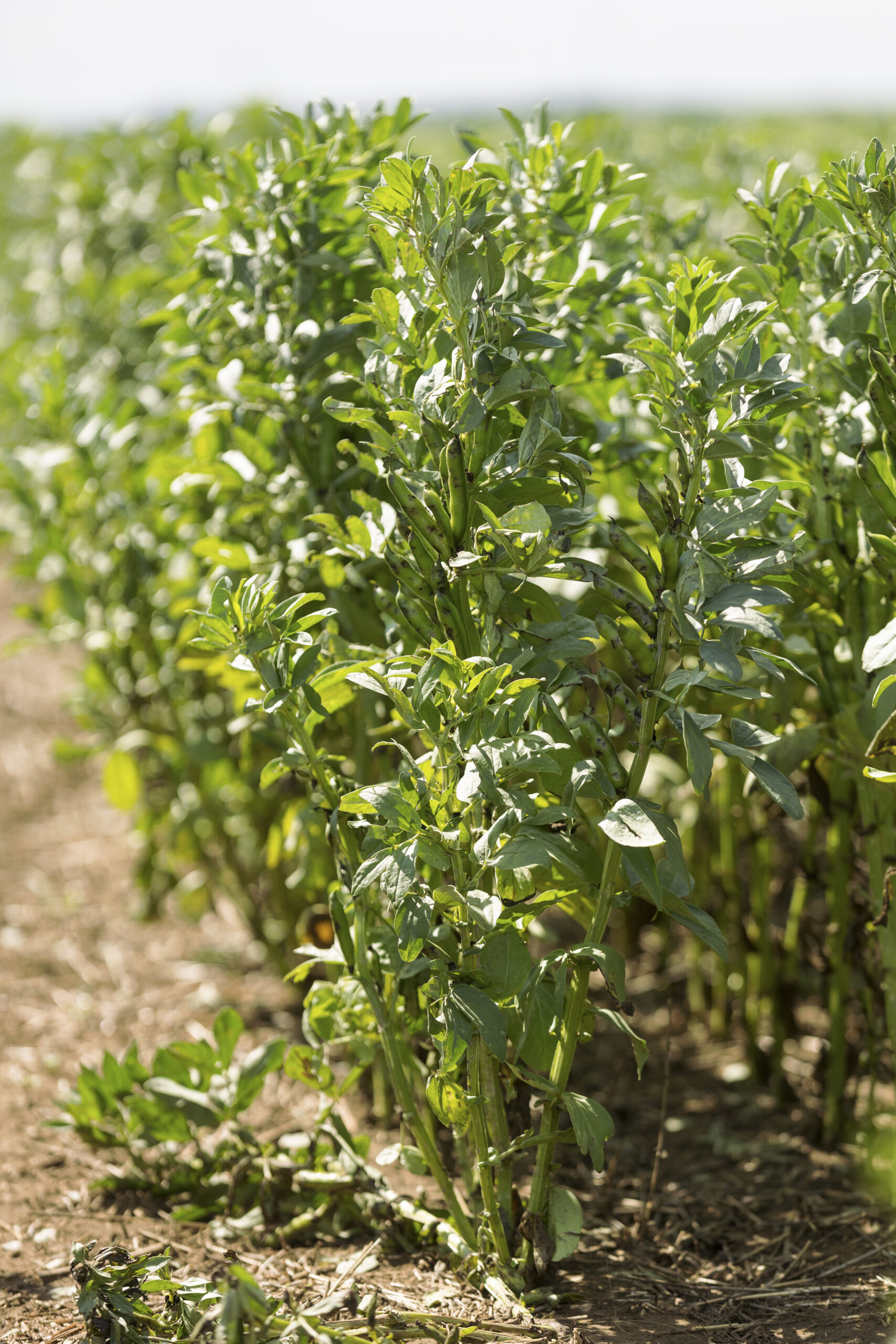
Many individuals within the population started flowering 40 to 42 days after sowing. Importance was placed on full plant maturity, but for many of these plants, colour change occurred only in some pods, or the main stem remained green. One hundred of the earliest plants were selected for advancement to a future small-plot early-maturity trial.
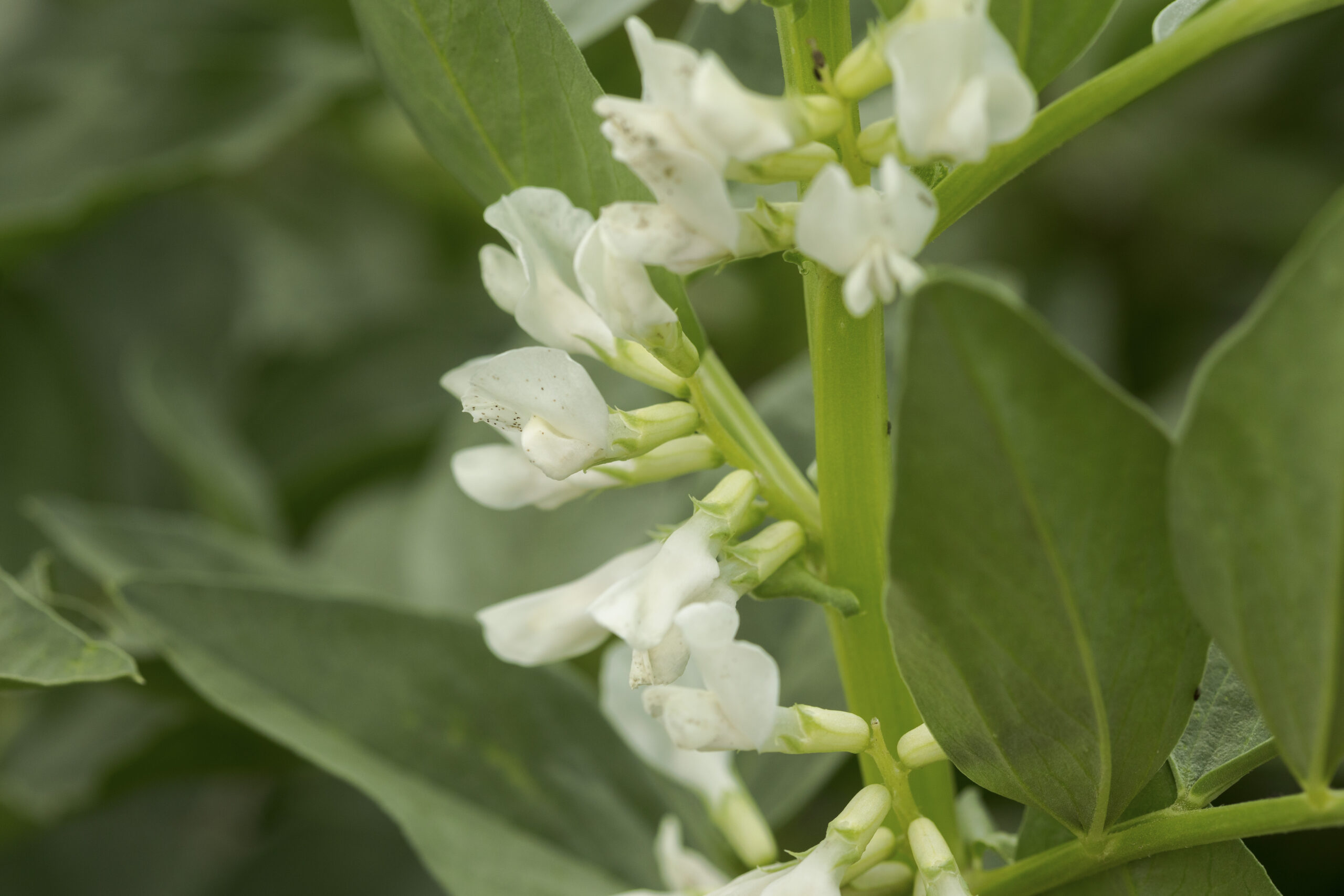
A phenotype in a subset of faba bean with a terminal end was tested during this project. It was hypothesized that this terminal end could be developed into early-maturing varieties. Plants with this terminal end grow and develop flowers and pods at successive nodes, but the main stem eventually stops growing, and the pods start to darken. Although this plant type still shows indeterminate growth through the early portion of flowering, it gets a signal to complete its lifecycle during the flowering stage. During this project, the plants that showed this phenotype continued to produce new stems from the base, even as the main stem matured. As a result, although the early-developed pods dried down earlier than the adapted material, many green pods remained on the later-developed stems, making an early harvest impossible. Therefore, the 2024 selection was made only from fully dried-down plants, and no individuals exhibiting this phenotype were selected.
Chocolate Spot Field Trials
Chocolate spot infections were much more severe in both 2023 and 2024 than in 2022 due to switching to an isolate that provided a more effective response.
Highly diseased individuals were manually removed within and between lines, and the earliest-maturing pods were selected to ensure that the pollen source was a selected male parent.
The lines of interest selected and crossed in 2023 and 2024, as well as those developed with newly introduced germplasm, all exhibited chocolate spot symptoms. Alterations to the infection protocol enabled a greater range of responses to disease pressure. Differences in symptom severity enabled the selection of individuals with less severe visible symptoms for further crossing, but no line fully resisted infection.
As a result of this project, pipelines of populations developed through selection are now available to test in small-plot trials for advancement and increase.
Implications for Growers
Faba beans are often amongst the last crops to be harvested in the growing regions where they carry the most promise. This delayed maturity is risky, so the development of earlier-maturing lines would make faba bean far more attractive for Saskatchewan farmers to add to their rotations. As faba bean acreage increases, chocolate spot is likely to become more prevalent unless resistant varieties become commercially available in the province.
Material developed during this project can be used to breed new cultivars with improved agronomic performance, allowing Saskatchewan farmers to increase production and meet potential future demand while simultaneously reducing risk.
Future Research
Further research is needed before faba bean varieties that mature earlier and/or possess greater chocolate spot resistance can be released. The new populations with traits of interest developed during this project still need to be tested in plot trials, and effective testing for chocolate spot at the small-plot scale will require developing larger disease nurseries.
Additionally, there is a severe bottleneck in domesticated faba bean germplasm, including a concerning lack of significant chocolate spot resistance, which signals the need to develop a population with complex mutations to increase genetic diversity and aid in identifying chocolate spot resistance genes. Continued breeding to reduce chocolate spot symptoms must also include an analysis of whether the reduction in symptoms effectively mitigates yield losses.