Background
Lentils are a popular choice among Saskatchewan growers as pulse crops, with impressive growth in acres seeded in recent years: acres seeded in 2024 were up 15% from 2023 (Statistics Canada, 2025). Lentils tend to have lower input costs and higher profit margins, especially green lentils, compared to other pulses such as peas.
Furthermore, pulse crops like lentil, pea, and soybean—effective nitrogen (N) fixers—can reduce the synthetic N required for subsequent crops in the rotation, including wheat (Liu et al., 2024).
While the economic incentive to grow lentils or other crops is a key driver of decision-making, Saskatchewan growers require more rigorous, region-specific data on lentil nutrient requirements, the timing of those requirements throughout the growing season, and associated yield potential to improve crop and nutrient management strategies.
Lentil & Fertilizer—What’s the Deal?
Lentil can acquire most of its required N via biological N fixation (up to 80%, according to Saskatchewan Pulse Growers). The remaining N demands are met through N present in the soil or mineralized in the soil over the growing season.
In 2021 and 2022, Chris Holzapfel and team conducted a study under Saskatchewan Agriculture’s Agriculture Demonstration of Practices and Technologies (ADOPT) Program to evaluate lentil response to fertilizer and inoculation. They applied varying fertilizer treatments to lentil plots at Indian Head, Swift Current, and Scott and measured responses over two growing seasons. Some of their key findings included:
- Applying inoculant—a product that introduces N-fixing bacteria on or near the pulse seed and, subsequently, the soil—is important to maximize N fixation in lentil. Effective inoculation reduces input costs associated with applying N fertilizer later in the growing season, especially on grounds where pulse crops have not been grown before or for a few years.
- If inoculation is not performed or nodulation fails, N fertilizer may still be applied during the growing season to meet the lentil crop’s nutrient requirements. There were some positive yield responses to supplemental N fertilizer, but a cost-benefit analysis would be required to determine profit margins.
- Phosphorus (P) amendments can significantly contribute to high-yielding lentil crops, considering that P is a limiting factor on many Saskatchewan soils. On P-limited soils, Holzapfel and the team noted that lentil yield increased with increasing P-fertility (fig. 3). Growers should test their soils to determine their operation’s baseline rates and apply P via sideband placement if needed.
In addition, Zakeri et al. (2012) found that applying N fertilizer to lentil resulted in a fertilizer-reliant crop and reduced biological N fixation. In a study in south-central Saskatchewan, rates of N fertilizer greater than 10 kg N/ha applied in the seed row of lentil as 28-26-0 blend were found to reduce the proportion of N derived from biological fixation and reduce emergence (Dona et al., 2019).
Nutrient Uptake & Biomass Accumulation
Lentils tend to have lower nutrient uptake rates and amounts than peas (Malhi et al., 2007). This translates to lower nutrient demands and, therefore, lower nutrient uptake and removal rates.
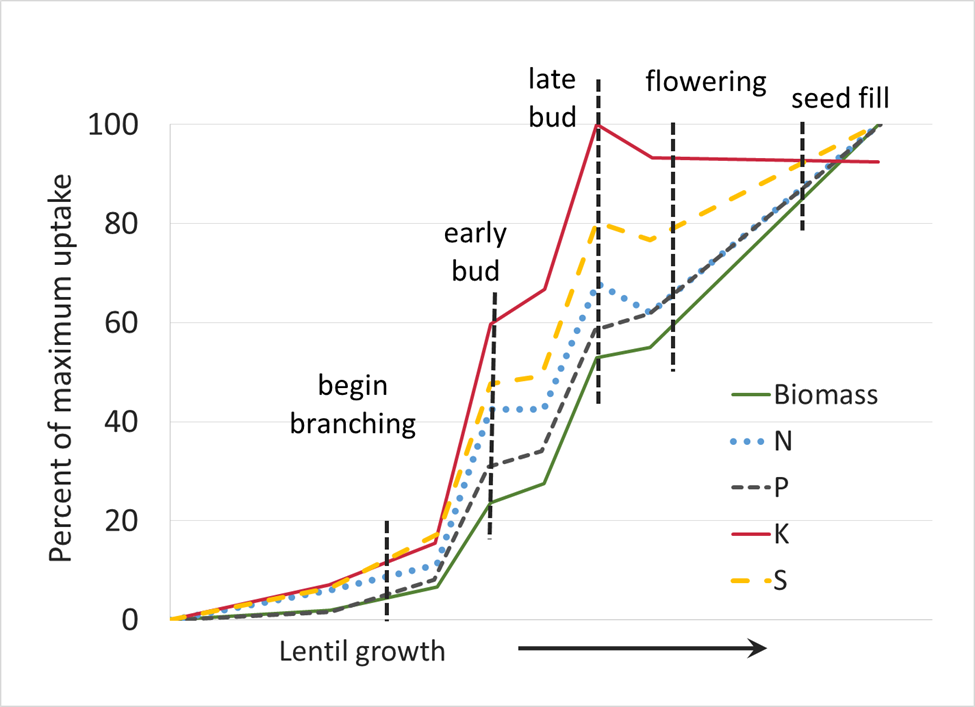
A study from Melfort, Saskatchewan, in 1998 and 1999 found that the highest rates of nutrient uptake in lentil occurred between 66 and 85 days after emergence (DAE), around the flowering or seed fill stage (fig. 1, fig. 2). Peak biomass accumulation rates occurred between 42 and 56 DAE, or around the bud formation stage (Malhi et al., 2007).
Yield
A multi-site study in Saskatchewan examining the 2014 and 2015 growing seasons found that lentil consistently yielded less than pea and soybean (Xie et al., 2018).
Lentil grown without the addition of phosphorus fertilizer had lower grain yield compared to lentil that received fertilizer amendments (fig. 3) (Holzapfel et al., unpublished)
While lentil yield can be lower than that of other pulse crops, the return on investment can still be comparable to those of other pulse crops, partly due to its lower nutrient demand and record-high market prices in recent years (Statistics Canada, 2025).
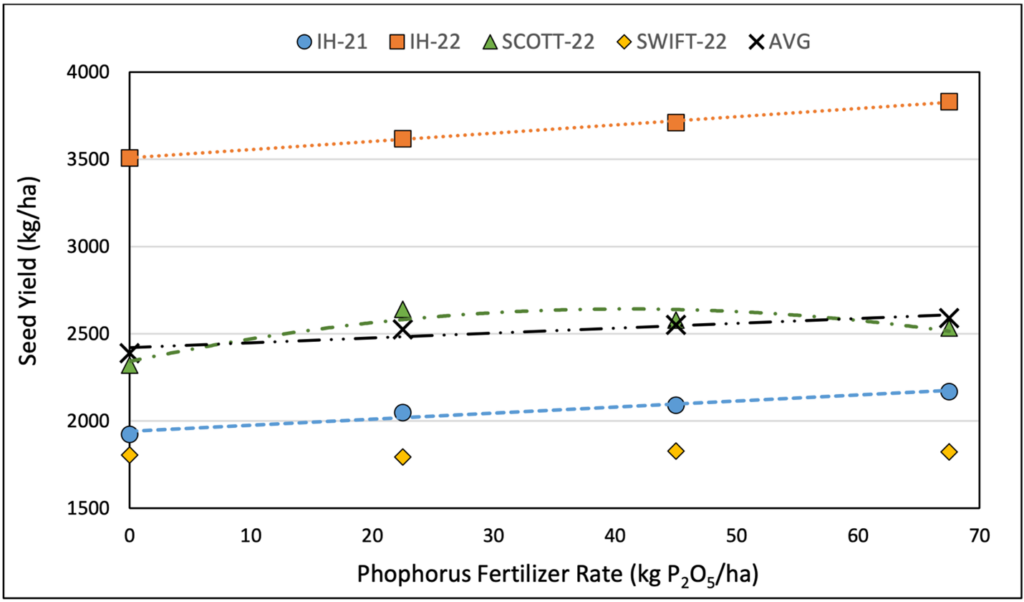
IH-21 = Indian Head site in 2021
IH-22 = Indian Head site in 2022
SCOTT-22 = Scott site in 2022
SWIFT-22 = Swift Current site in 2022
Summary
In brief, lentil production often benefits from P amendments because Saskatchewan soils generally have low P levels. Additional nitrogen is typically unnecessary unless the crop fails to nodulate sufficiently, limiting its ability to fix its atmospheric N. The highest nutrient demand in lentils generally occurs around the flowering stage, so ensuring nutrient requirements are met before then is important for meeting yield potential.
Despite its tendency towards lower yields, the return on investment for this pulse crop can be high, particularly given market demand. As such, lentil is one of the top crop choices for prairie pulse growers and is consistently growing in acres planted across the province.
References
- Dona, W.H.G., Schoenau, J.J. and King, T. 2019. Response of Soybean and Lentil to a Seed-Row Placed Starter Nitrogen-Phosphorus Fertilizer Blend in a Brown Chernozem in South-Central Saskatchewan. American Journal of Plant Sciences. 10: 1813-1829.
- Liu, L., Knight, J. D., Lemke, R. L., and Farrell, R. E. 2024. Quantifying the contribution of above- and below-ground residues of chickpea, faba bean, lentil, field pea and wheat to the nitrogen nutrition of a subsequent wheat crop. Field Crops Research. 313, 109412.
- Malhi, S. S., Johnston, A. M., Schoenau, J. J., Wang, Z. H. and Vera, C. L. 2007. Seasonal Biomass Accumulation and Nutrient Uptake of Pea and Lentil on a Black Chernozem Soil in Saskatchewan. Journal of Plant Nutrition. 30(5): 721 – 737.
- Saskatchewan Pulse Growers. N.d.. Lentil Reproductivity & Maturity Staging Guide. https://saskpulse.com/resources/lentil-reproductive-maturity-staging-guide/
- Statistics Canada. 2025. Canada: Outlook for Principal Field Crops, 2024. https://agriculture.
canada.ca/en/sector/crops/reports-statistics/canada-outlook-principal-field-crops-2024-07-22#a4 - Xie, J., Schoenau, J. and Warkentin, T.D. 2018. Yield and uptake of nitrogen and phosphorus in soybean, pea, and lentil and effects on soil nutrient supply and crop yield in the succeeding year in Saskatchewan, Canada. Canadian Journal of Plant Science. 98(1): 5-16.
- Zakeri, H., Bueckert, R., Schoenau, J., Vandenberg, A. and Lafond, G. 2012. Controlling indeterminancy in short-season lentil by cultivar choice and nitrogen management. Field Crops Research. 131(2012): 1-8.