Background
As soybean production grows in Saskatchewan, demand for more advanced, context-specific nutrient recommendations is increasing. Currently, soybean nutrient recommendations in Saskatchewan are often based on those for other pulse crops or on soybean recommendations from other ecozones, where precipitation, heat units, and yield targets are higher.
Research by Xie et al. (2018) aimed to provide Saskatchewan growers and agronomists with Prairie-specific data on yield, nitrogen (N) fixation, and impact on the succeeding crop to aid in making regionally relevant crop management decisions for a selection of pulse crops, with a focus on soybean.
Methods
Three varieties each of soybean, lentil, and pea were seeded at four sites in Saskatchewan (Rosthern, Saskatoon, Scott and Yorkton) in 2014 and 2015, followed by hard red spring wheat (Rosthern, Saskatoon, Scott) or canola (Yorkton). The experiment was arranged in a randomized complete block design (RCBD) with four replicates per site. All four sites had loam soils, with pH ranging from 5.9 to 7.9.
Soybean was pre-treated with ApronMaxx® RTA® fungicide and inoculated with Granular TagTeam® inoculant at twice the label rate since soybean had not previously been grown in the selected locations. Double inoculation is recommended in that scenario. Soybean was seeded at a rate of 65 seeds/m2 (~113 kg/ha or ~101 lbs/ac) with 35cm (~14″) row spacing. Fertilizers were not applied because soil tests showed sufficient nutrient levels before seeding.
Table 1: Soil, precipitation, and temperature information for the four experimental site locations
| Site | Soil Classification | Total Precipitation (May-August) (mm) | Mean Temperature (May-August) (°C) | ||||
| 2014 | 2015 | Historical average (1983-2013) | 2014 | 2015 | Historical average (1983-2013) | ||
| Rosthern | Orthic Black Chernozem | 220 | 144 | 258 | 15.1 | 16.4 | 15.3 |
| Saskatoon | Orthic Dark Brown Chernozem | 258 | 206 | 203 | 15.2 | 16.3 | 15.5 |
| Scott | Orthic Dark Brown Chernozem | 379 | 144 | 216 | 17.2 | 15.1 | 16.4 |
| Yorkton | Orthic Black Chernozem | 389 | 205 | 266 | 15.4 | 16.0 | 15.5 |
In both years of the study, soybean was hand-harvested. After threshing out the grain and weighing all aboveground plant material to determine yield, the residues were returned to the field and lightly tilled into the soil to avoid blowing away.
N and phosphorus (P) contents of both the grain and straw were determined in the lab (Thomas et al., 1967), as well as soil nitrate, sulphate, and a suite of micronutrients (Houba et al., 2000; Lindsay & Norvell, 1978). Soil available N and P were also monitored at the Saskatoon and Rosthern sites during the 2015 growing season.
Yield, Nutrient Partitioning & Crop Impact
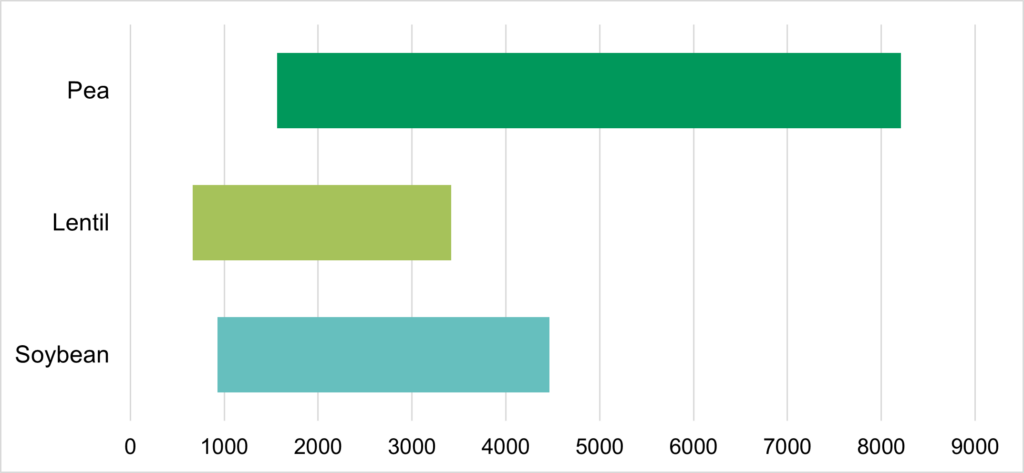
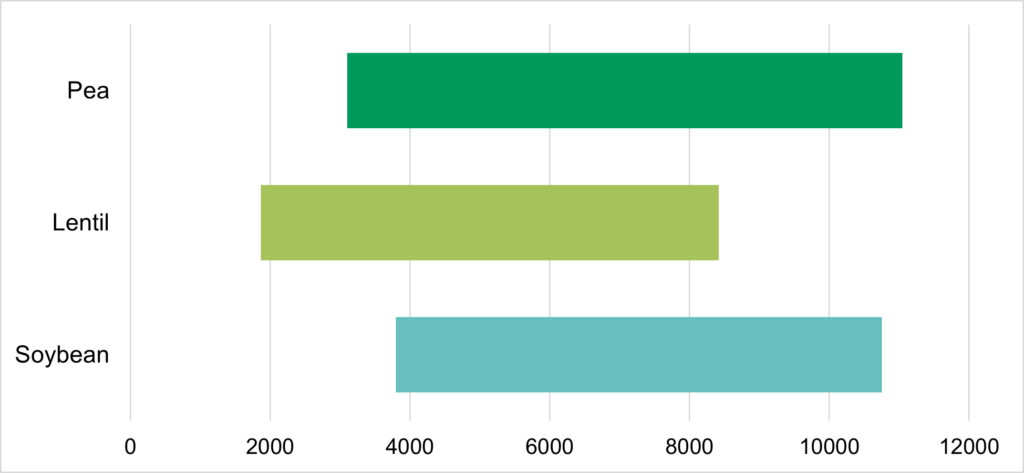
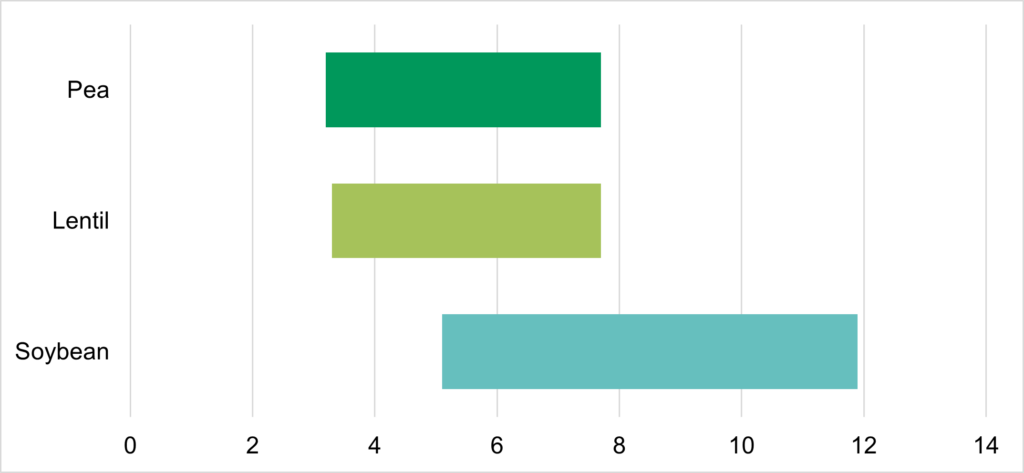
Soybean grain yields in this study ranged between 929 and 3,534 kg/ha (Figure 1), and straw yields were between 3,799 and 6,955 kg/ha (Figure 2). While lentil grain yields were slightly lower on average, soybean yields overall were similar to those of pea and lentil, and within the range of the provincial average.
Soybeans generally had higher N and P concentrations in the grain (39.3–47.6 g/kg and 5.1–6.8 g/kg, respectively) than pea and lentil (figures 3 and 4). Compared to peas and lentils, soybeans had significantly higher potassium (K), calcium (Ca), magnesium (Mg), and sulphur (S) concentrations in the grain across sites and similar or greater removal of these nutrients, suggesting the potential for additional depletion of these elements from the soil over the long term when soybeans are grown.

In Rosthern and Saskatoon, where soil available N and P were monitored in 2015, soil P supply was similar regardless of the previous crop. In Rosthern, soil N levels were significantly lower following soybean than following lentil. In Saskatoon, N levels were similar despite differing previous crops. Overall, the rotational inclusion of soybean did not appear to cause any nutrient deficiencies in the subsequent crop in the short term, nor did the inclusion of pea or lentil.
Summary
Soybean yields tend to be lower in Saskatchewan than in the United States (U.S.). Midwest and Eastern Canada, mainly due to Saskatchewan’s comparatively cooler, drier environment. However, as temperatures rise, soybean production in Saskatchewan is increasing (Xie et al., 2018).
While this study found soybean yields to be lower than those commonly achieved in warmer climates, they were still similar to those of peas and lentils grown in Saskatchewan and within the range of provincial norms.
In the short term, soybeans did not remove primary nutrients at rates higher than those expected for other pulse crops, such as pea and lentil. For the most part, soybeans meet their nitrogen needs through biological nitrogen fixation. However, due to higher K and P concentrations in soybean grain, K and P levels should be monitored for potential nutrient depletion in the long term if soybeans are used in rotation. In these cases, nutrient levels may need to be adjusted beyond the typical pulse crop recommendations to mitigate the risk of nutrient depletion for succeeding crops.
References
- Houba, V.J.G., Temminghoff, E.J.M., Gaikhorst, G.A., and van Vark, W. 2000. Soil analysis procedures using 0.01 M calcium chloride as extraction reagent. Communications in Soil Science and Plant Analysis. 31(9–10): 1299–1396.
- Lindsay, W.L., and Norvell, W.A. 1978. Development of a DTPA soil test for zinc, iron, manganese, and copper. Soil Science Society of America Journal. 42(3): 421–428.
- Thomas, R.L., Sheard, R.W., and Moyer, J.R. 1967. Comparison of conventional and automated procedures for nitrogen, phosphorus, and potassium analysis of plant material using a single digestion. Agronomy Journal. 59(3): 240–243.
- Xie, J., Schoenau, J. and Warkentin, T.D. 2018. Yield and uptake of nitrogen and phosphorus in soybean, pea, and lentil and effects on soil nutrient supply and crop yield in the succeeding year in Saskatchewan, Canada. Canadian Journal of Plant Science. 98(1): 5-16.