

With active breeding programs in dry beans, peas, and faba beans, research funding remains a cornerstone of both immediate progress and long-term resilience for Canada’s pulse sector. Strategic investments in breeding through the Pulse Cluster not only drive genetic improvement but also strengthen grower profitability and maintain Canada’s competitive edge in global markets. As we work to breed new varieties—tailored to regional conditions, equipped with stronger disease resistance, and aligned with evolving market demands—producers are gaining the tools they need to farm more efficiently and sustainably.
Improving Production Efficiency and Disease Resistance for Dry Beans
Dry bean adaptation is regional. Cultivars of pinto, great northern, yellow, black, and red beans, developed in Ontario and Manitoba, with more than 105 frost-free days, do not mature in the short growing season of Alberta and Saskatchewan, which have fewer frost-free days.
“Our objectives are to improve production efficiency and profitability of dry beans by selecting genotypes that not only mature early but are also more resistant to white mould and common bacterial blight,” states Dr. Parthiba Balasubramanian, Agriculture and Agri-Food Canada (AAFC) research scientist and lead researcher for the Selection of Early Maturing Dry Bean Germplasm and Cultivars for Sustainability and Improved Productivity Under Irrigation research project. “When developed, these cultivars will require fewer inputs of fertilizer, water and/or fungicide, enhancing profitability for growers.”
AAFC Research Scientist Dr. Jamie Larsen, one of the lead researchers of The AGGI Project: Accelerated Genetic Gain and Improvement, is advancing dry bean germplasm enhancement and breeding, developing disease-resistant, high-performing varieties, and deepening research on bacterial blight resistance. This research activity is a collaboration with activity co-lead Dr. Valerio Hoyos-Villegas (McGill University/Michigan State University), Dr. Peter Pauls (University of Guelph), Dr. Mohsen Yoosefzadeh Najafabadi and Dr. Anfu Hou (AAFC Morden), Ahmed Abdelmagid (AAFC Morden), Dr. Nick Larkan (AAFC Saskatoon) and Dr. Parthiba Balasubramanian (AAFC Lethbridge). Scott Chalmers and Dana Maxwell are industry partners who do off-site dry bean testing in Manitoba. The main research sites for this activity are AAFC Harrow, AAFC London and AAFC Morden, with farmer collaborators happening in St. Thomas, Ontario.
“We expect one cultivar to be supported for registration this year,” states Dr. Larsen. “This will have them grown for breeder seed and then, if licensed, provided to farmers for full-scale production (within the next decade).”
In parallel, researchers are addressing another major challenge in pulse production—the soybean cyst nematode (SCN). Because seed treatments offer only limited suppression of SCN in dry beans, developing genetic resistance is essential for long-term management.
“Understanding the range of genetic tolerance across different dry bean market classes is a critical first step toward identifying the genes responsible and ultimately developing cultivars with improved resistance across all classes,” states Chris Gillard, lead researcher of The Interaction of Climate Change with Pest Management and Fertility in Dry Bean research project.
Genomic Improvement of Faba Beans
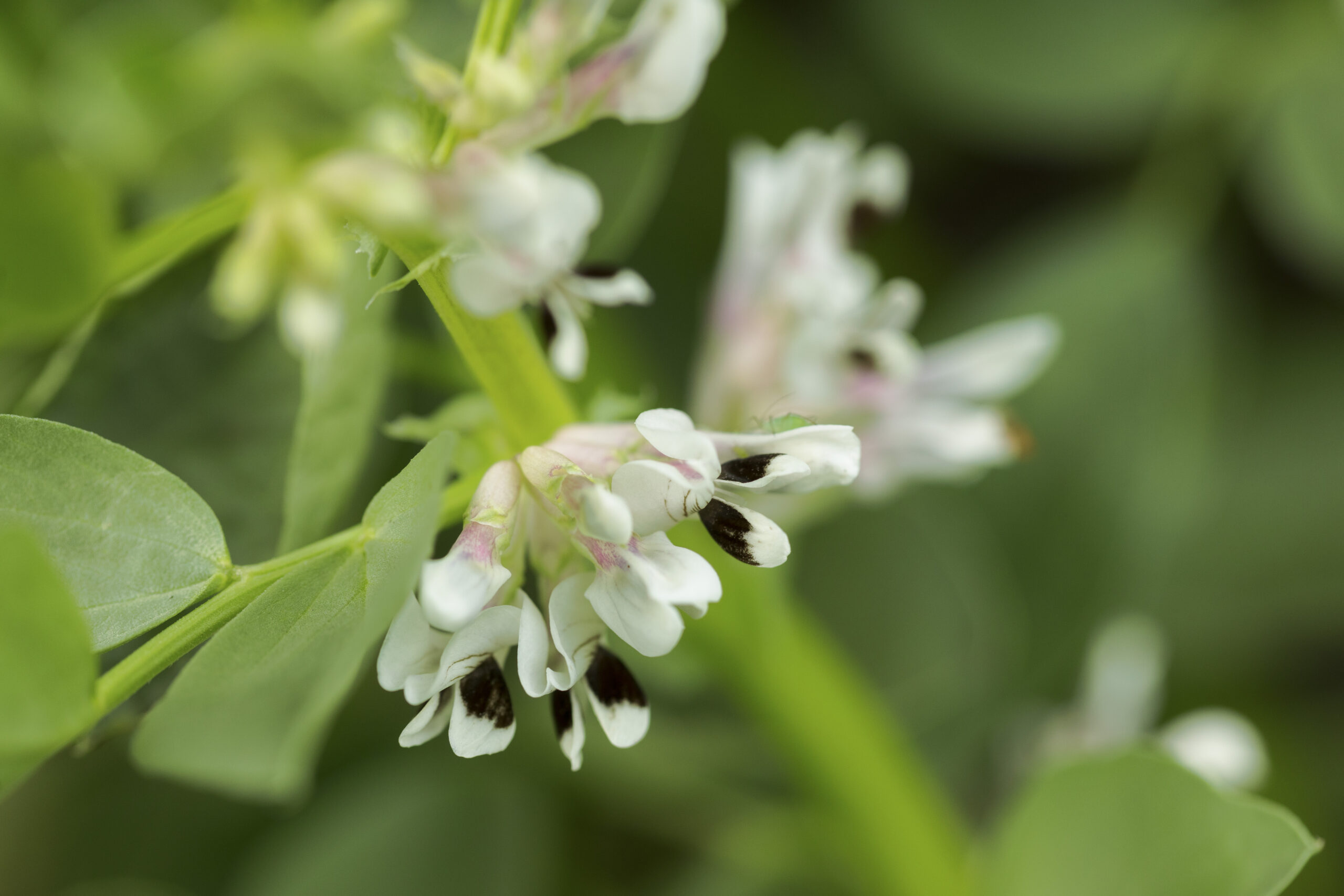
Faba beans hold significant untapped potential, particularly within the rapidly expanding plant-based protein sector. To fully position faba beans as a reliable rotational pulse across large acreages in Canada, targeted genetic improvement is needed. While traits such as yield, harvestability, and protein content are priorities in most crops, faba beans require greater focus on maturity and water-use efficiency to support their adaptation to new, more variable growing environments.
Researchers are currently evaluating a diverse set of faba bean germplasm in field trials across Alberta and Manitoba. These trials assess yield, plant height, flowering time, lodging resistance, disease resistance, and seed traits to identify the genetic factors most valuable for breeding programs in Western Canada.
“We have already leveraged the genetic material for other projects on genetic adaptation to climate change, image-based seed trait analysis, and expanding the faba pan-genomics initiative,” explains AAFC Research Scientist Dr. Nicholas Larkan, lead researcher of the Diversity Set for Genomic Improvement of Faba Bean research project. “By analyzing the faba diversity set across multiple field sites, we are generating data that will help pinpoint the genetic drivers most important for future faba breeding efforts in Western Canada.”
Market Attributes
Improving profitability for growers depends not only on reducing production costs and increasing yields, but also on ensuring the new cultivars meet the functional needs of the marketplace, including for processing. University of Saskatchewan Professor Dr. Tom Warkentin, lead researcher of the Development of Improved Pea Cultivars to Enhance Canada’s Leading Role in International Pea Markets research project, places significant emphasis on developing pea varieties that not only perform well in the field but also have attributes that perform well in end-use applications, such as for protein processing.
Several key processing functionality traits that are tested include:
- Water Holding Capacity (WHC): High WHC helps minimize shrinkage during cooking, which is especially important for applications such as plant-based burger patties.
- Foaming Properties: These characteristics are valuable for products that rely on aeration, including coffee foams, plant-based whipped creams, meringues, and various baked goods.
- Emulsion Stability: Strong emulsion stability ensures reliable performance in emulsified foods such as plant-based egg alternatives, dressings, and sauces.
- Protein Solubility: This attribute is essential for liquid applications, including plant-based beverages and sports nutrition products.
By aligning breeding priorities with these market-driven traits, Dr. Warkentin’s work helps ensure new pea cultivars deliver value across the entire supply chain, from growers to processors to consumers.
Conclusion
Canada’s pulse sector is at a pivotal moment, with strategic research investments shaping the varieties growers will rely on for decades to come. From improving disease resistance in dry beans to unlocking the genetic potential of faba bean and refining pea attributes for emerging food markets, these breeding projects are laying the groundwork for a more resilient, profitable, and competitive industry. As researchers continue to identify traits that matter both in the field and on the plate, producers gain access to varieties that perform better, require fewer inputs, and meet evolving market expectations. Sustained funding ensures this momentum continues, supporting innovation today while securing the long-term strength of Canada’s pulse industry.
Research Projects
- Development of Improved Pea Cultivars to Enhance Canada’s Leading Role in International Pea Markets
- Principal investigator: Dr. Tom Warkentin
- Cost: $4,239,829
- Diversity Set for Genomic Improvement of Faba Beans
- Principal investigator: Dr. Nicholas Larkin
- Cost: $636,415
- Selection of Early Maturing Dry Bean Germplasm and Cultivars for Sustainability and Improved Productivity Under Irrigation
- Principal investigator: Dr. Parthiba Balasubramanian
- Cost: $1,225,495
- The AGGI Project: Accelerated Genetic Gain and Improvement
- Principal investigator: Dr. Jamie Larsen
- Cost: $2,211,537
- The Interaction of Climate Change with Pest Management and Fertility in Dry Bean
- Principal investigator: Chris Gillard
- Cost: $850,300