By Chuck Penner, LeftField Commodity Research
September 2026
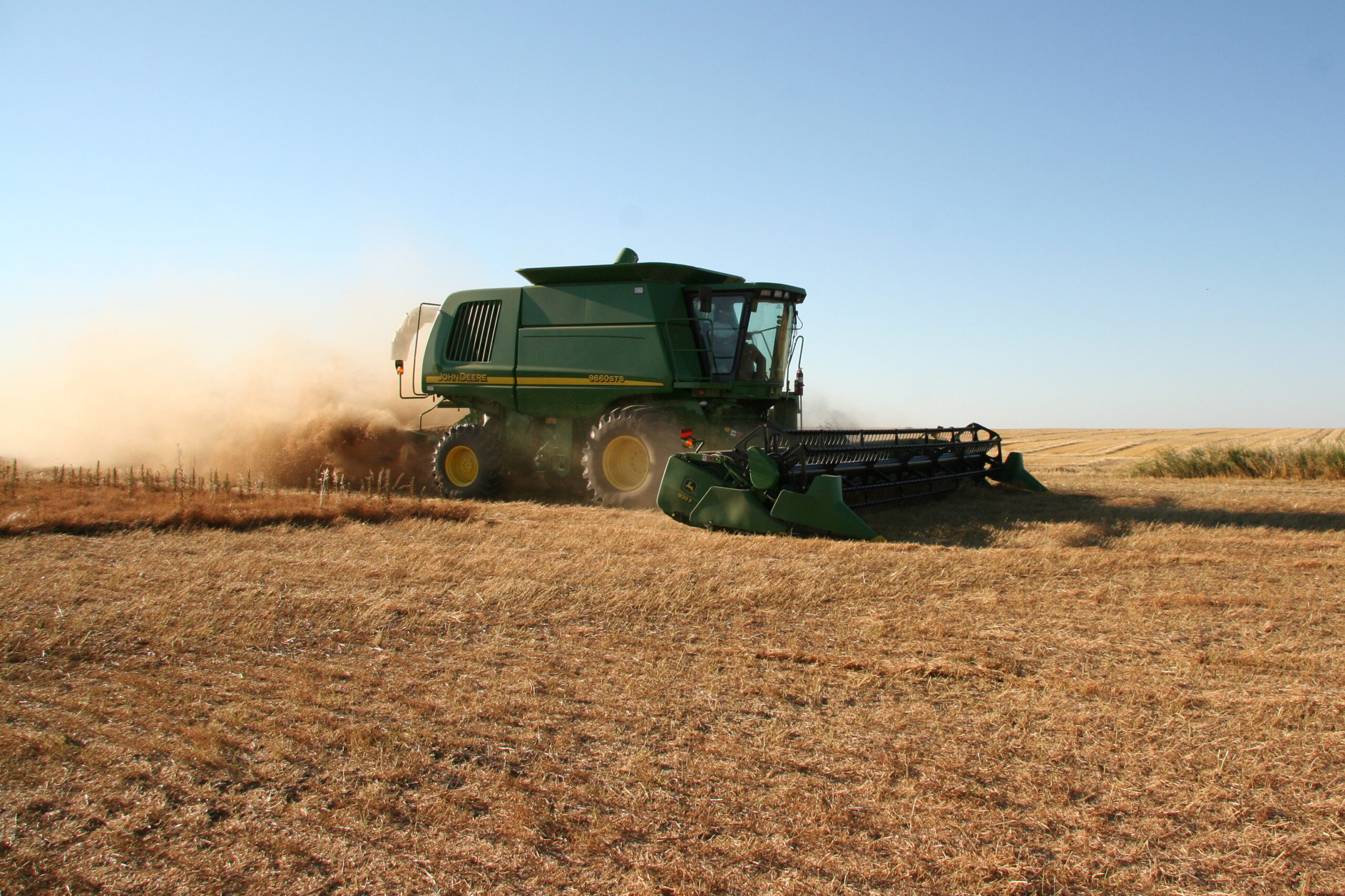
It has been another year of weather extremes across the prairies, as excess moisture in spring gave way to summer heat, and now harvest rains are slowing the combines. The pulse harvest is running well behind normal – less than half of Saskatchewan’s peas were off as of late August versus a ten-year average closer to three-quarters – and early yield reports keep coming in below what the good-looking crop stands had promised. Statistics Canada’s first production survey is still a couple of weeks away, but our own projections point to smaller 2026 crops for all three major pulses. That said, large old-crop carryovers of green peas, green lentils, and chickpeas will cushion some of the declines in total supplies, so the impact varies considerably from one crop, and even from one class to the next.
The bigger change in recent months is on the demand side. India has been importing lentils at a very strong clip this summer and its monsoon rains are running behind, China’s pea imports remain well above average, and Pakistan is buying record volumes of chickpeas. At the same time, shipping barriers out of the Black Sea region are limiting Canada’s largest competitors. Prices for most pulses look like they have already put in their seasonal lows, and the combination of smaller Canadian supplies and stronger export demand sets up a friendlier price environment than the last two falls – although the strength will not be spread evenly.
One common theme from early pea harvest reports is that yields are coming in lower than expected. We have pegged the prairie-wide yield at 36.7 bushels per acre (bu/ac), about 5% above the longer-term average but well below last year’s high. Applied against the 16% drop in yellow pea acreage, that puts the yellow pea crop at 2.31 million tonnes, 27% less than last year, while the green pea crop would be down 22% at around 450,000 tonnes. The harvest delays are also a concern; continued rains raise the risk of quality losses.
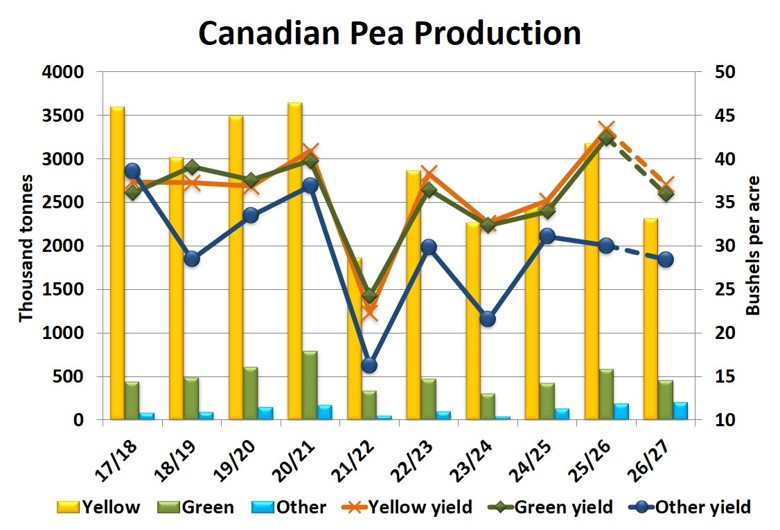
Normally a smaller crop would simply mean fewer exports but this year, competitors are struggling. Production among the major pea exporters (including Canada) is forecast down 1.5 million from last year’s peak, and shipping barriers in the Black Sea region are limiting Russian and Ukrainian movement. The clearest demand signal is from India, where yellow pea prices jumped in the last two weeks of August to the highest levels since mid-2024, a move that looks like buyers are worried about access to Canadian and Russian supplies.
Early lentil yield reports range all the way from single digits to 30 bu/ac, showing the effects of spring moisture and the summer heatwave in the Southern growing areas. Our bias is toward a below-average yield overall. That would mean a red lentil crop about 10% smaller than last year, while green lentil production could fall by more than half from 2025’s big crop. The catch for greens is the massive old-crop carryover, which offsets most of the drop in production and leaves 2026/27 supplies down only 8% at 1.66 million tonnes, weighted heavily toward small greens. Red lentil supplies would slip below 2 million tonnes, 12% less than last year.
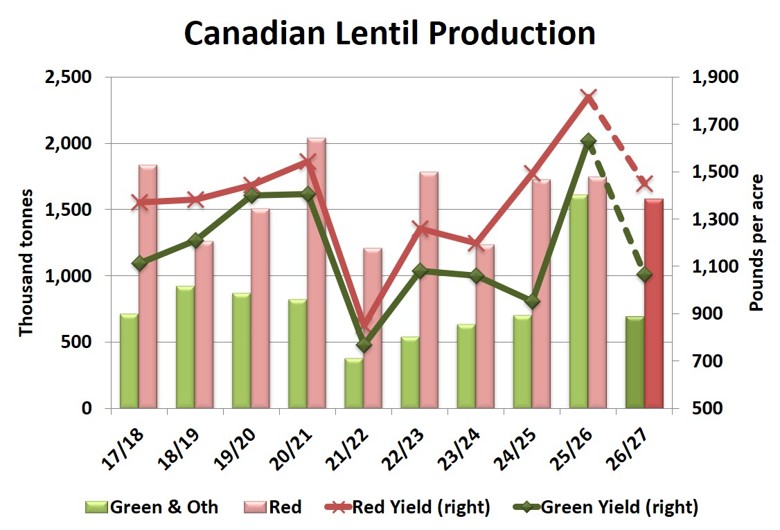
Demand is not waiting for harvest to wrap up. Indian lentil imports have been above the five-year average every month since January, and the first quarter of its marketing year brought in a record 390,800 tonnes, more than double a year ago. With monsoon rainfall running 13% behind average and some key pigeon pea areas facing large deficits, that appetite could persist well into 2026/27. Canadian exports have already started at an unusually early pace. The main counterweight is Australia, where favourable rains could push its crop to 2.25 million tonnes or more, keeping the red lentil trade competitive.
Chickpeas are the exception on the supply side. Even though we expect the 2026 crop to drop by more than 100,000 tonnes, the old-crop carryover is estimated 150,000 tonnes larger, pushing total 2026/27 supplies to around 650,000 tonnes, even bigger than last year’s record. The United States (U.S.) crop is headed the other direction, with acreage declarations pointing to production down 27% at around 225,000 tonnes, which should reduce our largest customer’s homegrown supplies.
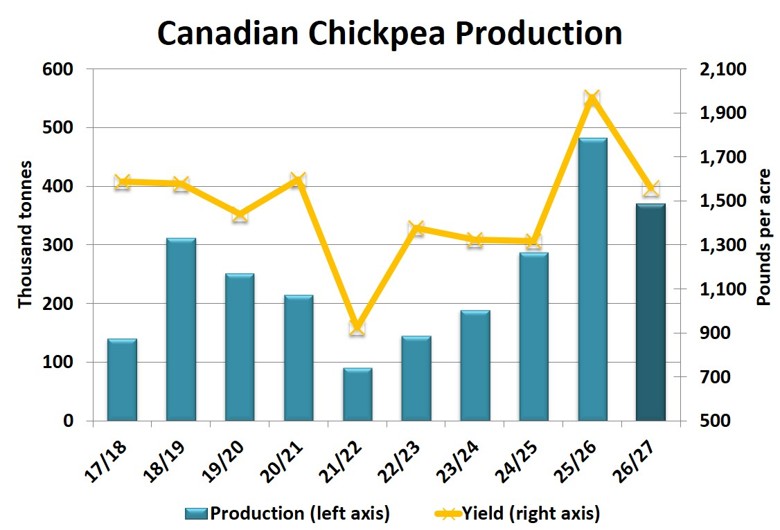
The demand signals are also hopeful for chickpeas. Pakistan’s chickpea imports are running at a record pace, at 471,600 tonnes through the first seven months of 2026, and its usual top suppliers face problems – a smaller Australian crop ahead and Russian shipping difficulties – that could send more of that business toward Canada, including for smaller-calibre kabulis. Concerns about Indian pulse production could prompt its imports to start earlier than usual.
One final note on dry beans: insured acreage of black beans is down over 40% in Canada with pinto area down by a third, mirroring the drop in U.S. plantings, and U.S. crop ratings remain well below average. Those markets have already started to respond, another example of how quickly the price picture can change once supplies tighten.
Taken together, a smaller pulse harvest and a hungrier export market give growers better price prospects than the last two falls – with patience through harvest likely to be rewarded.
Chuck Penner operates LeftField Commodity Research out of Winnipeg, MB. He can be reached at info@leftfieldcr.com.