By Chuck Penner, LeftField Commodity Research
October 2026
It looks like pulse markets in 2026/27 are going to shape up quite differently than 2025/26. And by differently, we mean better. Production always varies from year to year and no question, those changes have a large influence on the market. This year though, the demand side of the equation could provide the majority of the stimulus for the friendlier 2026/27 outlook. Compared to the last couple of years when pulse markets were in more of a “supply-push” environment, 2026/27 looks like it will be much more of a “demand-pull” situation.
Peas
Pea production among major exporters jumped sharply in 2025 to 11.4 million tonnes, due to much larger crops in Canada and Russia, the two dominant competitors. While 2026 pea production was not exactly small, Canadian and Russian production dropped by a total of 1.2 million tonnes, partly offset by gains in other smaller exporters.
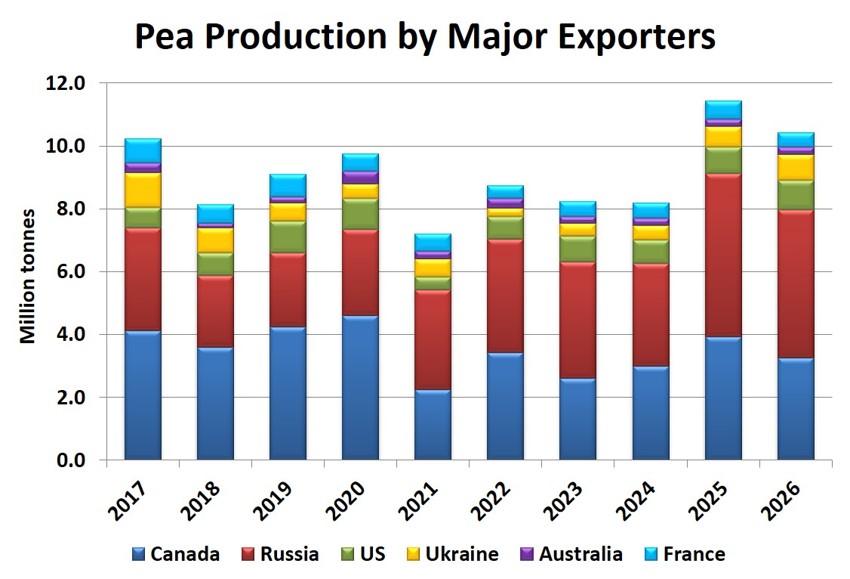
In the case of Russian peas, the smaller crop could be less of a factor than its ability to export peas. Disruptions in shipping caused by attacks on infrastructure are severely constraining export capabilities and non-core crops such as pulses could be lower on the priority list. Ukrainian pea production is up in 2026, but its exports are even more affected by the ongoing attacks. As a result, buyers will look for more reliable shipping, with Canada as the only sizable source of peas.
Even if demand would be flat in 2026/27, the current situation would be positive for the Canadian pea market, especially yellows. But there are numerous signs that the pull on Canadian peas in the coming months will be even stronger than last year. For example, through the first eight months of 2026, China imported a record 1.85 million tonnes of peas, far exceeding the average pace of 1.18 million tonnes. And looking ahead, current price relationships in China suggest these volumes could actually increase further into late 2026 and early 2027. Likewise, Indian pea imports in the first four months of its 2026/27 marketing year (starting in April) were 525,000 tonnes, almost double last year’s pace. Increased pea imports by these two dominant destinations are clear signals that the pull on pea supplies, especially yellows, will remain strong in 2026/27.
The recent sharp rise in Indian yellow pea and desi chickpea prices is another strong indicator of a positive demand outlook. This rally has several likely causes, including smaller Canadian and Russian crops, shipping constraints from the Black Sea region and a smaller Australian desi chickpea crop. But possibly most important and yet to be fully factored in, India’s monsoon rains have been short in the kharif season and could cause problems for its next rabi (winter) pulse crop which includes chickpeas, peas, and lentils. If so, India’s demand for pulse imports would rise further and could trigger a reduction in its import tariffs, currently 30% on peas.
Lentils
The situation for lentils is best understood by looking at greens and reds separately. The two dominant origins for red lentils are Canada and Australia, with two very different outlooks for 2026/27. While the Canadian red lentil crop will drop 5-10% from last year, estimates for Australian red lentil production are at record levels (and rising). The combined crop of the two countries will likely top 4 million tonnes, up from 3.9 million in 2025/26, but this increase in production could easily be overshadowed by larger demand in 2026/27.
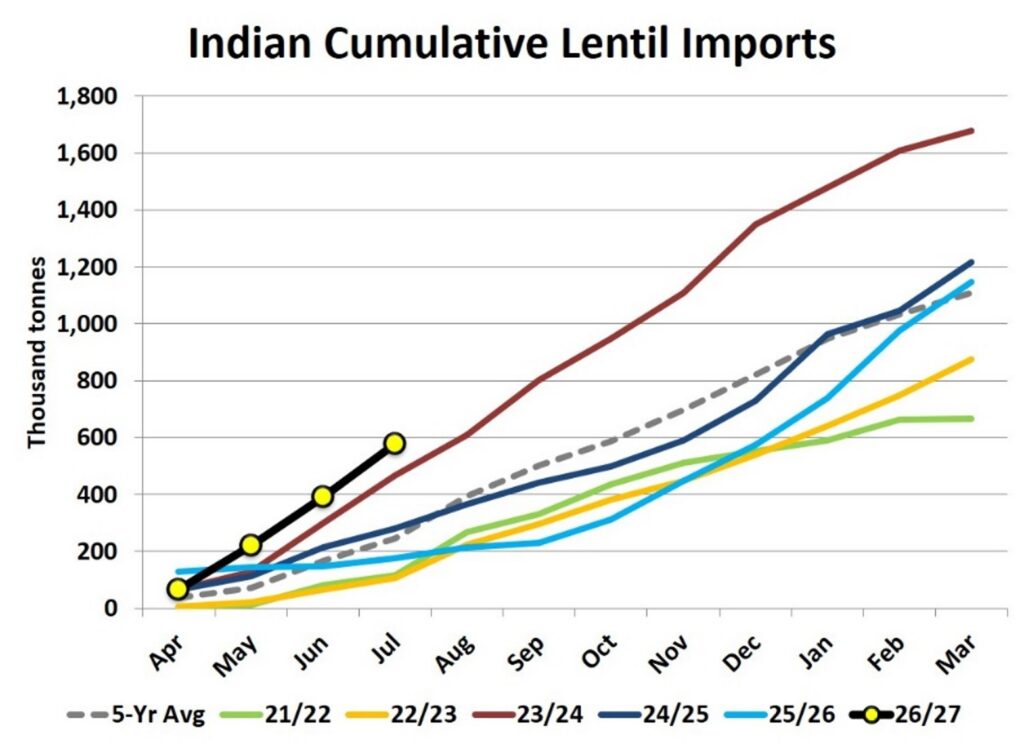
The shortfall in India’s monsoon rains has not caused red lentil prices there to rise in a meaningful way, at least not yet. There are a few possible reasons, including expectations of a record Australian crop and sizable buffer stocks within India. But it is worth noting that Indian lentil demand has already been very strong leading up to the monsoon season. Just four months into India’s 2026/27 marketing year, total lentil imports reached 578,000 tonnes, a record pace by a wide margin. These large imports have helped keep a lid on Indian lentil prices so far but if demand rises further due to lower Indian production this winter, the price impact could be much larger. Demand from other South Asian countries could also rise due to El Niño effects.
India could also end up being the key linchpin in the green lentil market. In fact, the recent gains in Canadian bids may be the result of Indian demand. Indian green lentil imports from Canada can be quite variable but rose in 2025/26 and will likely expand further in 2026/27. The expected drop in India’s pigeon pea harvest this fall caused by monsoon deficits could boost green lentil import needs as a key substitute. Canada and, to a lesser extent, the US, Russia, and Kazakhstan, are the main green lentil producers and production is reported lower for all four countries in 2026. There are still large carryover supplies, but strong demand from India would help pull down inventories.
We are already seeing some early signs of rising demand for pulses. Prices are strengthening in destination markets and bids in Western Canada have turned higher. Some of these gains are simply the normal seasonal price behaviour but the postharvest response appears stronger than it has been in several years. Keep in mind, the seasonal highs for peas and lentils are still a few months away, suggesting that the rallies are still in their early stages.
Chuck Penner operates LeftField Commodity Research out of Winnipeg, MB. He can be reached at info@leftfieldcr.com.