By Jon Driedger, LeftField Commodity Research
October 2026
The environment for most pulses looks positive for the coming year, although it will vary by crop. The outlook will also partially be a function of how much demand relies on global markets, and Canada’s place in world trade. Unlike some other crops, Canada has a relatively small footprint within the global faba bean and soybean markets, although how much they rely on international trade differs.
Faba Beans
Statistics Canada showed faba bean plantings at just 51,300 acres in 2026, the lowest total since 2013 and continuing the steady decline of the past few years. There is no official production estimate yet, but reports suggest yields could be a little better than average. This may leave a crop size of around 60,000 tonnes, compared to a 5-year average of 85,000 tonnes.
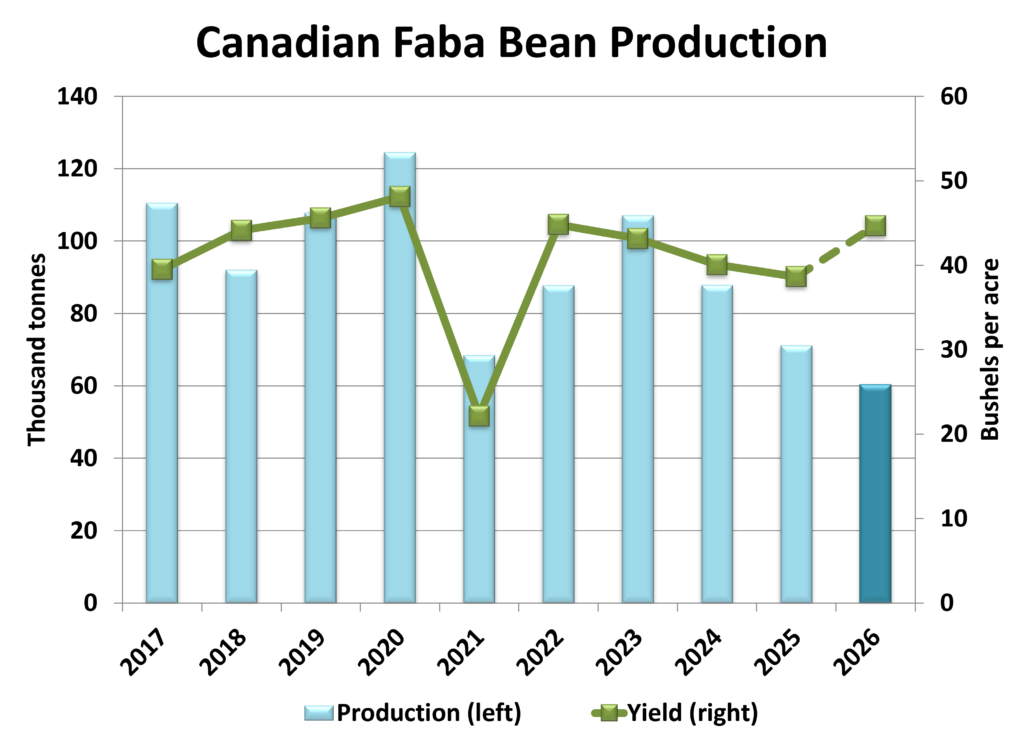
Most of Canada’s faba beans are consumed domestically, between processing and livestock markets. The challenging prairie harvest may see more lower-quality pulse supplies overall which could provide more competition in feed markets, although this may be offset by a friendly price outlook for peas and strong soymeal and canola meal prices.
As much as domestic use has been the primary source of faba bean demand in recent years, exports saw meaningful improvement in 2025/26 despite a smaller crop. Shipments reached 22,413 tonnes, the most since 2019/20, representing just over 30% of production. The United States (U.S.) took over half of the total with South Korea receiving much of the rest, while smaller volumes went to Egypt and Morocco.
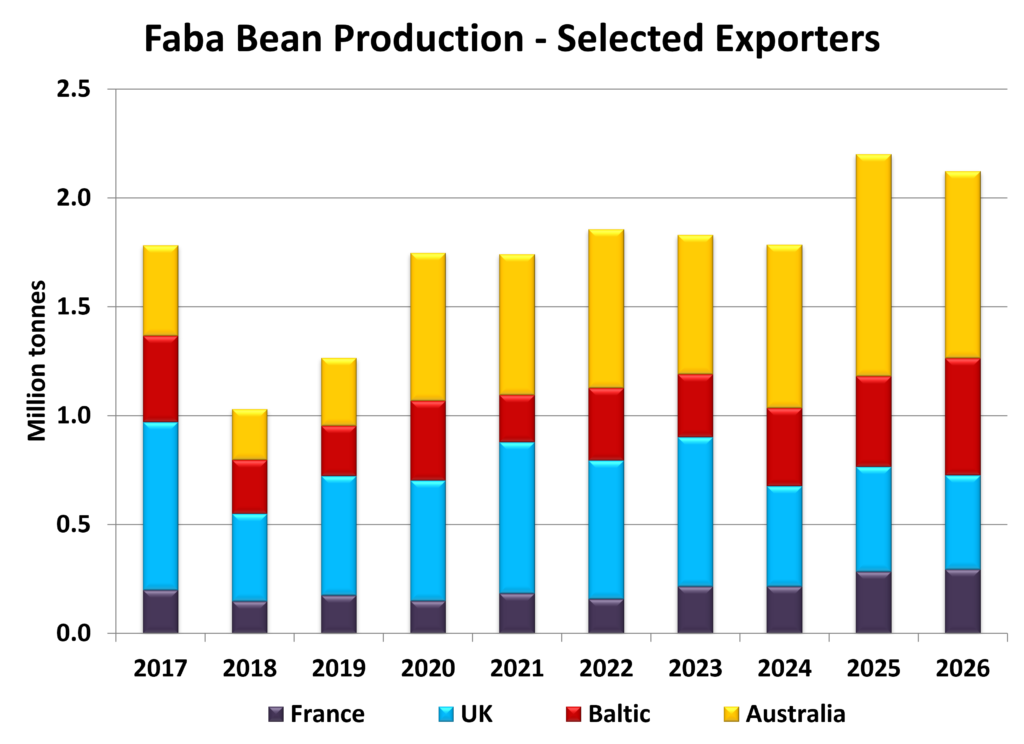
There is potential for export growth given Canada’s small share of global trade, particularly if production starts to increase again. But this also means competing against countries that grow much larger crops and are well-established suppliers. Recent estimates of faba bean production among key exporting countries show a total crop of around 2.14 million tonnes, slightly behind last year’s record. Australia’s crop may be down by 16%, to around 860,000 tonnes, but still historically large. United Kingdom (U.K.) production is expected to fall about 10% to 430,000 tonnes. But this will be nearly offset by an increase in production in Lithuania and Latvia, which combined may produce about 537,000 tonnes. In addition, Australia has a large overhang of old-crop supplies after last year’s big harvest, which is weighing on prices. Canada’s relatively small crop, and with U.S. as a primary export customer, means there is less reliance on overseas markets for now. But that would change if production started to increase, including competing with other large exporters into key markets such as Egypt, or developing potential new outlets such as China.
Soybeans
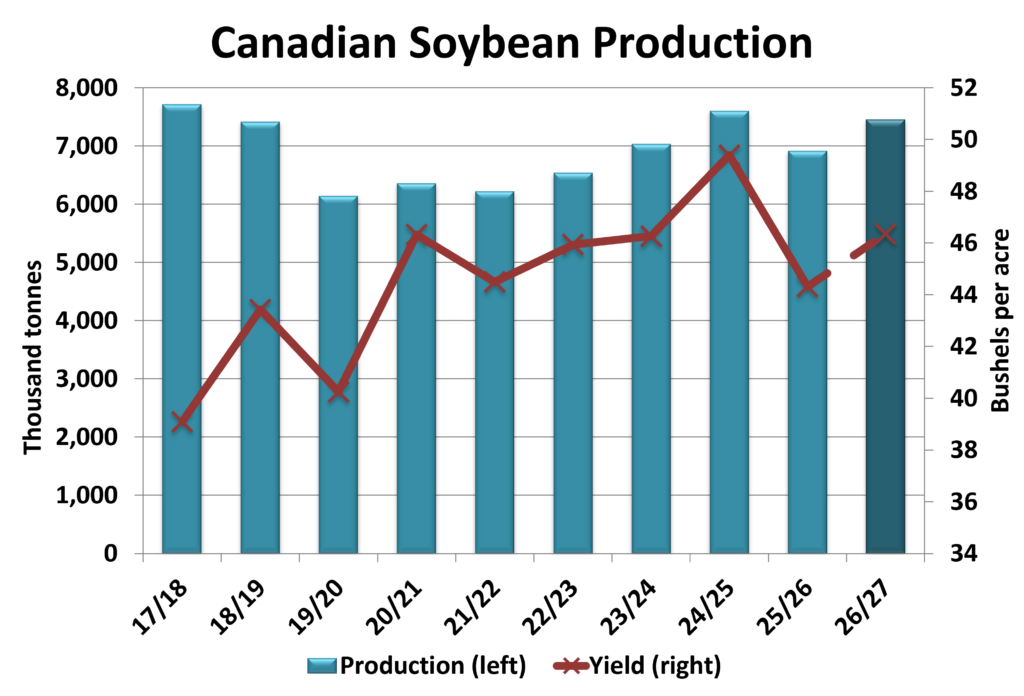
Soybean seeded area has been trending higher in Canada over the past six years, with Statistics Canada’s 2026 estimate of 5.96 million acres the largest since 2018. While most production is in Eastern Canada, acres have been increasing on the prairies as well the past few years. Statistics Canada’s initial production estimate is 7.46 million tonnes, the second largest since 2017, helped by reasonably good growing conditions. This includes a crop of up to 2 million tonnes in Western Canada, the highest in eight years.
Canada exports most of its soybeans, with movement close to 5.50 million tonnes the past two seasons, as larger crops allowed for more shipments. It is possible exports could be even higher in 2026/27 due to bigger supplies. Canada is a relatively small exporter, and subject to global market conditions, although also has a diverse customer base. China was the largest destination in 2025/26, taking roughly 40% of Canada’s shipments, but the rest of the volumes were well distributed across multiple countries in Asia, the Middle East, and Europe.
Perhaps more than any other crop, soybean markets can be heavily influenced by government policy. Crush volumes have increased to record levels in the U.S., with growing biofuel demand for soybean oil being a key driver. The U.S. Department of Agriculture (USDA) is expecting biofuel use to be over half of total U.S. soybean oil consumption in 2026/27, pushing U.S. prices above global levels. But biofuel demand is driven by regulations, which can change or go through periods of uncertainty. The trend towards increasing biofuel production seems well entrenched, but potential policy shifts can result in market volatility along the way.
China is by far the world’s largest export destination for soybeans, taking over 60% of total shipments. The U.S. share of this business is connected to trade policy between the two countries that extends beyond agriculture. Given China’s importance, shifts in expectations around how much they may, or may not, take from the U.S. can create market uncertainty. The current USDA outlook for the U.S. 2026/27 balance sheet is relatively tight, so even a moderate swing in China’s purchases of U.S. soybeans can either add cushion (if volumes are lower), or squeeze supplies even further (if commitments are higher).
South American production will also shape the global outlook. The combined Brazil and Argentine crop was record-large in 2025/26, and early expectations are for big output again in 2026/27. But the full growing season is still ahead, and the effects of El Niño on South American conditions is a bit uncertain.
The price outlook for most pulse crops is positive going into winter, but many markets have also already seen notable gains from the earlier lows. How much additional strength is possible will vary by crop. In addition, the current geopolitical climate keeps uncertainty high, increasing the importance for growers to stay on top of markets.
Jonathan Driedger is Vice President with LeftField Commodity Research. He can be reached at jon@leftfieldcr.com.